
A wheat field near Elberta, Utah, just became the most technically sophisticated wheat field on Earth, thanks to a talented team of BYU professors and students.
The team of engineers placed 86 Bluetooth devices throughout the 50-hectare (124-acre) field to measure water levels across every inch of the field. Placing this many sensors in a commercial field is unprecedented and allows researchers to see unique patterns that have never before been captured.
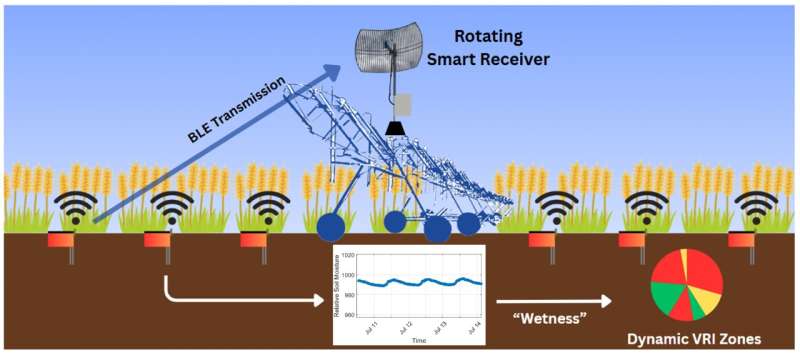
Each of these sensors, called BYU Smart Bluetooth Stakes, is powered by a credit-card-sized solar panel and uses two metal prongs to gauge the soil moisture as often as every minute. The system is significantly more accurate than traditional water saturation measurement methods and provides a map of where water is needed.
“We took existing technology—they’re the same kind of microchips that would be inside your Bluetooth headphones—and we put them on a platform, added solar powering, probes to measure soil moisture, and then just made the whole package waterproof and outdoor-capable so that it could be left for a long period of time,” said Ph.D. student and team member Samuel Craven. “They have to be really small, low enough to the ground that a farmer’s tractor can go over top of it, and cheap enough that we can do hundreds of them.”
The project is part of Craven’s dissertation and was published in the journal Sensors.
The smart Bluetooth stakes are placed prongs-down in the ground and work together with a smart receiver attached to a center pivot sprinkler system. An important finding from their research showed that switching to a parabolic antenna for the smart receiver significantly improved signal strength and range. The receiver was able to collect data more reliably across the field, especially from distant stakes, with a range increase from 300 meters to 600 meters.
Getting to that point required extensive research and experimentation. BYU electrical and computer engineering professor Brian Mazzeo pulled together an interdisciplinary research team of students and faculty—including plant and wildlife sciences professor Neil Hansen and geography professor Ruth Kerry—to take it on.
“We decided to go with Bluetooth because it’s inexpensive, it’s readily available, the wavelengths, everything. There are a lot of things that made it very attractive, but the research itself, goes beyond that,” Mazzeo said. “Somebody may come up with a better wireless solution, and that’s okay, but understanding the density of sensors necessary is a critical question that farmers and other agricultural professionals need to know.”
Working through a drought is an expected challenge for farming in the West, including the desert lands of Utah. The BYU Smart Bluetooth Stakes provide a way to deliberately use water resources in the ways farmers need them and better navigate drought conditions while still maintaining healthy crop production.
“We’re solving real, practical problems,” Kerry said. “It’s very heartening to realize we can solve these problems if we work together.”