
Urinary tract infections (UTIs) are among the most common bacterial infections, with catheter-associated UTIs accounting for more than half of infections contracted in hospitals. When detected early and accurately, UTIs are treatable. Current diagnostic methods can be slow or inaccurate, creating a need for improved methods.
Led by Dr. Hatice Ceylan Koydemir, researchers from the Department of Biomedical Engineering at Texas A&M University, have developed a wearable catheter sensor that, with the aid of a smartphone app, can detect UTIs at an earlier stage than traditional methods. This new system has the potential to reduce patient complications caused by untreated UTIs.
“For patients who may need urinary catheters—such as older adults, post-surgical patients, or people with chronic conditions—these results mean that in the future, UTIs and catheter-associated UTIs could be detected earlier and more conveniently, without having to wait days for a lab culture or rely only on low-sensitivity dipsticks,” said Dr. Weiming Xu, a former Ph.D. student in the biomedical engineering department and primary researcher on this project.
Traditional diagnostic methods include urinalysis and urine cultures. Urinalysis typically involves assessing urine color and odor, along with a dipstick test to detect infection indicators, like pH or blood. While a urinalysis can be done quickly, the tests are less sensitive than other methods, leading to false negatives. Urine cultures are more reliable, but the tests can take up to two days, allowing more time for an infection to progress.
Researchers have designed a smartphone app that is compatible with the sensor to serve as a remote control, provide data analysis, and alert users when infection is detected. The work is published in the journal Biosensors and Bioelectronics.
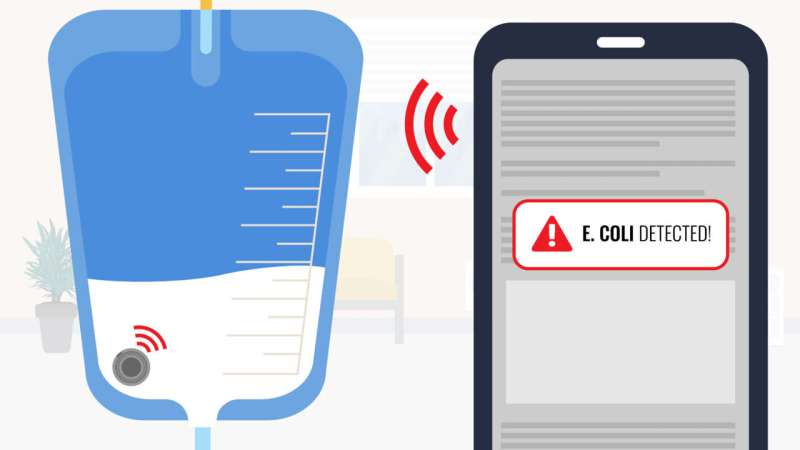
“The system works by having a small device stuck to the catheter bag to continuously monitor for E. coli. When detected, the sensor will send an automatic alert to a phone when infection is detected, enabling faster medical response, reducing the risk of serious complications like urosepsis, and potentially lowering hospital stays and health care costs,” said Xu.
Catheter-associated UTIs are most commonly caused by the bacteria E. coli, making the ability to identify its presence essential when it comes to diagnosis.
To do so, reagents that create a fluorescent light reaction in the presence of E. coli were pre-loaded into the catheter bags. The team’s novel wearable fluorescence sensor attaches to a catheter bag. Ultraviolet LED lights shine into the bag and detect the fluorescence caused by the reaction. A color sensor is used to monitor the sample, sending data to the smartphone app in real time.
The sensor was able to detect E. coli at lower levels than traditional methods in as few as three to nine hours. The research was performed using an in vitro bladder model, but these results show promise for earlier detection of UTIs. Next steps will include testing real patient samples to ensure clinical success.
The research was conducted at the Center for Remote Health Technologies and Systems, a part of the Texas A&M Engineering Experiment Station (TEES). Graduate students Majed Althumayri and Azra Yaprak Tarman contributed to key parts of the experimental work, each bringing their own set of specialized skills to the table.
“This project is very interdisciplinary in nature,” said Koydemir, an associate professor of biomedical engineering. “Having a team of students with expertise in different areas helps make the project more successful.”
Current graduate students in Koydemir’s lab are taking this research further by investigating ways to detect other pathogens besides E. coli and designing intravenous catheters to detect infections in the blood stream.