
Twenty years. That’s how long Robert Oman has been cancer-free, thanks to a clinical trial offered at the University of Rochester’s Wilmot Cancer Institute. And he isn’t alone: 70% of patients in the trial who had advanced-stage follicular lymphoma survived at least 15 years after completing a standard treatment regimen of immunotherapy and a chemotherapy combination, known as CHOP.
A new analysis of long-term data from the trial, published in JAMA Oncology, shows that 42% of treated patients were functionally cured—defined as having no chance of lymphoma recurring during their expected lifespan. That’s a game-changer for a disease long deemed incurable, due to its propensity to recur—sometimes many years later.
According to the study, recurrence rates declined drastically over time for patients treated with CHOP-based chemoimmunotherapy. The rate of disease relapse fell from 6.8% of patients relapsing in the first five years after treatment to only 0.6% relapsing between 15 and 20 years.
“When we started this trial 25 years ago, advanced-stage follicular lymphoma was considered incurable,” said Wilmot Director Jonathan W. Friedberg, MD, MMSc, who led the new study. “We expected the CHOP chemoimmunotherapy to be better than the standard treatment of the day, but never expected it would be curative. The fact that a subset of patients achieved cure is truly remarkable.”
Oman, who finished treatment in 2006, has never shown any sign of recurrence, an outcome that would have been highly unlikely if he hadn’t participated in the trial.
That’s a far cry from his father’s experience with lymphoma decades ago.
“My dad was in his 60s when we had it,” said the younger Oman. “He lived for 14 years, but he took seven rounds of chemo. It always came back. It would be like two years, and the cancer always came back.”
Oman, 65, of Campbell, NY, saw the toll lymphoma and the repeated rounds of chemotherapy took on his father and decided he would forgo treatment if he ever developed the disease, which carries a hereditary risk. But he didn’t expect to be diagnosed at 40 years old, with three sons at home.
“I didn’t really have a choice,” he said. “The decision was kind of made for me.”
At first, surgery to remove affected lymph nodes seemed to do the trick, but Oman’s follicular lymphoma returned in 2005 along with a tumor on his kidney. That’s when his oncologist at Guthrie Corning Hospital referred him to Wilmot for the phase 3 clinical trial, which was conducted by the SWOG Cancer Research Network.
The trial randomized 531 patients with untreated advanced-stage follicular lymphoma (45 of whom were enrolled through Wilmot) to one of two treatments built around a core chemotherapy regimen known as CHOP (cyclophosphamide, hydroxydaunorubicin, vincristine, and prednisone). One arm treated patients with rituximab immunotherapy plus the CHOP combination (R-CHOP), while the other arm used CHOP followed by radioimmunotherapy (CHOP-RIT).
Oman received CHOP-RIT, and he says it didn’t slow him down. “It was a temporary thing for six or eight months, and then I got back in the game.”
Unlike his father, he only experienced minor complications from either the disease or the treatment, missing just a few days at his job on a Cornell University potato farm and maintaining his own farm throughout treatment.
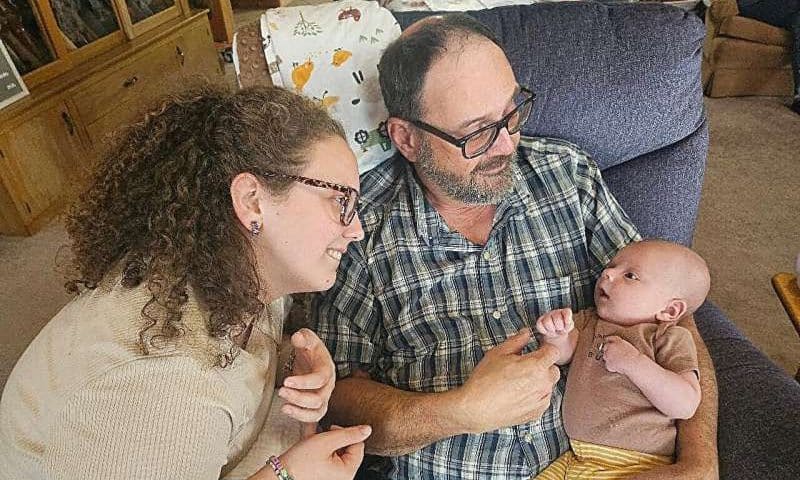
Oman is still active and says he has lived a normal life. Now, his sons are grown, and he’s been able to watch two of his grandchildren graduate from high school in recent years.
“I was extremely lucky and blessed to be able to see our first two grandchildren grow up, and now we’re starting a new chapter in our life with our newest grandson, born last October,” he said. “Having been through cancer, I appreciate life a little bit better.”