

Meditation is widely recognized for its extensive range of mental and physical health benefits, from reducing stress and anxiety to boosting cognitive and emotional health. What was considered a fringe activity is now a mainstream practice embraced by millions of people around the world. But how long does it take to reap the benefits?
A new study published in the journal Mindfulness reports that the first brainwave changes start at about two to three minutes and peak at around seven minutes.
Tracking neural activity
Previous research has told us a lot about where brain activity changes occur (such as the frontal and parietal regions) and which waves are involved (mainly alpha and theta), but one major unknown was how quickly these changes begin. To solve this, researchers led by a team from the National Institute of Mental Health and Neurosciences in Bengaluru, India, recorded real-time neural activity in three groups of volunteers who were performing Isha Yoga breath-watching meditation.
These were people with no experience of meditation, novices trained in the technique and highly experienced practitioners. Each person wore a cap equipped with 128 sensors that recorded electrical activity in the brain while they meditated.
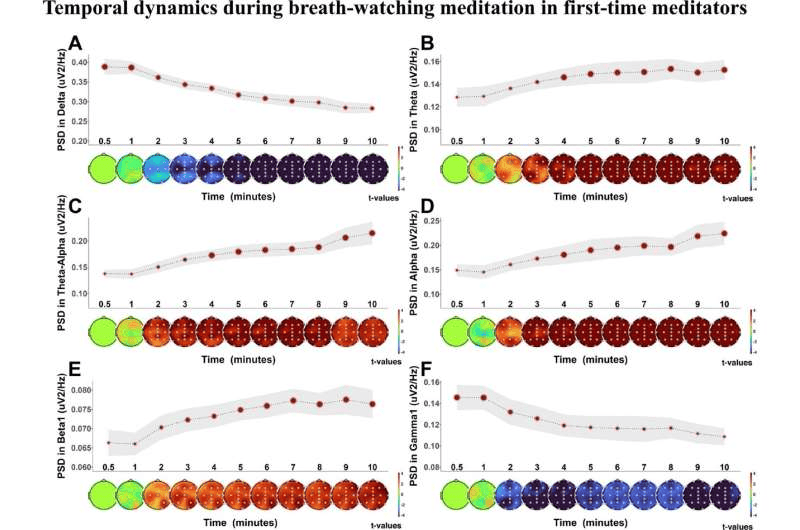
The results showed that while the timing of brain changes was similar for everyone, the strength and type of brainwaves differed based on experience level.
Typically, the brain begins to shift its electrical patterns within just two to three minutes, from everyday distractions toward a state of relaxed alertness where alpha and theta waves (linked to calm and focus) and beta 1 waves (linked with alert, engaged focus) rise.
Rapid response
At the same time, delta waves (associated with drowsiness) and gamma 1 waves also decrease. Although for advanced practitioners, a distinct brainwave signature was already visible at 30 seconds, suggesting they were responding differently from the start of the meditation. Meanwhile, the strongest brainwave changes occurred at the seven to ten-minute mark.
One of the most interesting findings was that experienced meditators don’t necessarily reach this peak faster than beginners. However, when they do, the brainwaves are significantly stronger.
“Our study suggests that the brain’s response to meditation can be rapid and varies with practitioners’ experience, potentially influencing cognitive and emotional processing in significant ways,” commented the team.
The research suggests that even if you lead a busy, high-pressure life, you only need a few minutes to begin seeing measurable brain changes linked to meditation, no matter your experience level or location. “Brief meditation practices of seven minutes or more—delivered through digital platforms—could offer accessible, effective, and scalable solutions for improving mental well-being.”