
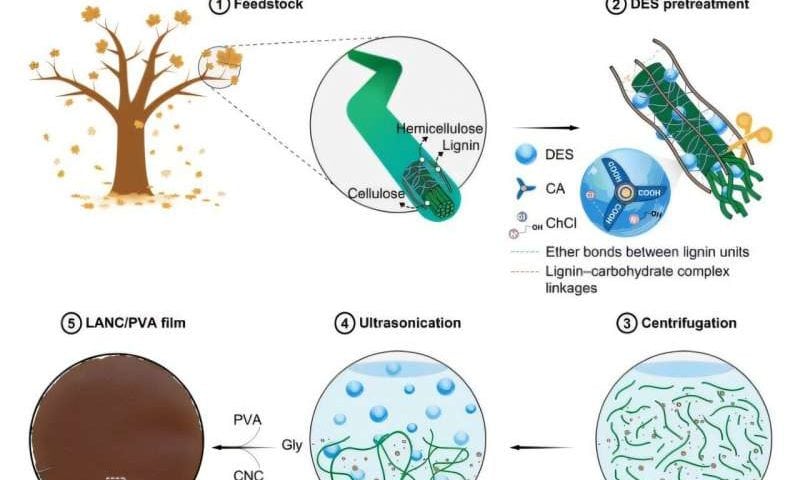
Fallen leaves, which are discarded every year, have been transformed into a resource that can replace waste plastics, a major nuisance in rural areas. A research team at the Korea Advanced Institute of Science and Technology (KAIST) has developed biodegradable agricultural vinyl made from fallen leaves, presenting a new way to solve the problem of conventional plastic vinyl, which is a cause of soil pollution. The study is published in the journal Green Chemistry.
The team, led by Professor Jaewook Myung of the Department of Civil and Environmental Engineering, developed an eco-friendly agricultural mulch film (an agricultural vinyl that covers the soil to suppress weeds and maintain moisture) that decomposes in the ground using fallen leaves collected from the campus and near the Gapcheon River in Daejeon. This research is significant in that it converted fallen leaves, which are non-edible biomass (plant resources not used for food) that were discarded as useless, into high-value functional materials.
Mulch films, widely used in agricultural fields, are essential materials for suppressing weed growth and maintaining soil moisture. However, most films currently used are made of polyethylene (PE, a representative petroleum-based plastic), making them difficult to collect after use. Residuals left in the soil turn into microplastics (plastic particles so small they are invisible to the naked eye), causing environmental pollution.
To extract the key components from fallen leaves, the research team used a hydrated deep eutectic solvent (DES, a special eco-friendly solvent with low toxicity) that mixes citric acid and choline chloride.
Through this, they extracted nanocellulose (plant-derived nanofibers with high strength and eco-friendliness) obtainable from plant cell walls and combined it with polyvinyl alcohol (PVA, a water-soluble and naturally degradable polymer material) to produce a composite film. The eco-friendliness was further enhanced by performing all manufacturing processes based on water instead of harmful organic solvents.
The “fallen leaf film” developed in this way showed sufficient performance even in actual agricultural environments. It effectively blocked ultraviolet rays (UVA and UVB) and exhibited moisturizing performance that suppressed soil moisture loss to a level of about 5% for 14 days. In addition, ryegrass grown using this film showed better growth status than cases where no film was used.
Biodegradation performance was also confirmed. As a result of testing under soil conditions, the developed film decomposed by 34.4% in about 115 days, showing a faster decomposition rate than conventional biodegradable films. Furthermore, it was confirmed that plant toxicity (harmful effects on plant germination or growth) did not occur during the decomposition process, thus not affecting the germination and early growth of ryegrass and bok choy.
Professor Jaewook Myung said, “This research is meaningful in that it went beyond simply processing fallen leaves and converted them into functional materials that can protect the agricultural environment. Through the use of fallen leaves that do not compete with food resources and water-based processes, it can be utilized as a sustainable alternative technology for agricultural plastics.”