
When most humans reach late adulthood, their ability to coordinate movements and maintain balance, broadly referred to as motor control, tends to gradually decline. While these changes in motor control are widely documented, the extent to which they also affect sensorimotor learning (i.e., the adaptation of movements based on information from the environment) remains unclear.
Researchers at University of California-Berkeley (UC Berkeley) and Carnegie Mellon University recently set out to better understand two distinct types of sensorimotor learning, referred to as explicit and implicit learning. Their paper, published in Nature Human Behavior, summarizes earlier findings in the field, while also presenting the results of new experiments.
“This project emerged from a longstanding puzzle in the motor learning literature,” Jonathan S. Tsay, senior author of the paper, told Medical Xpress. “Some studies suggested that aging impairs motor learning, others reported little change, and a few even found improvements in older adults. As researchers interested in how humans learn and adapt movement, we found these inconsistencies both fascinating and concerning.”
Combining a meta-analysis with new experiments
When they were reviewing earlier studies focusing on sensorimotor learning in late adulthood, Tsay and his colleagues realized that they often only involved small numbers of participants. In addition, many earlier works treated motor adaptation as a single process, rather than considering its implicit and explicit dimensions.
“Over the past decade, however, the field has increasingly recognized that sensorimotor learning reflects multiple interacting systems,” said Tsay. “In particular, there is an important distinction between implicit learning—the automatic, unconscious recalibration of movement—and explicit learning, which involves deliberate strategies and conscious problem solving.”
The researchers hypothesized that aging affects explicit and implicit learning systems differently. These differences could potentially explain why earlier studies gathered contradictory findings.
“To test this hypothesis, we took a two-pronged approach,” said Tsay. “First, we conducted a large systematic review and meta-analysis spanning several decades of research and more than 2,300 participants. Second, we carried out a series of new, well-powered experiments specifically designed to isolate implicit and explicit forms of learning. Ultimately, our goal was not simply to ask whether aging impairs motor learning, but rather to understand which mechanisms change with age and why.”
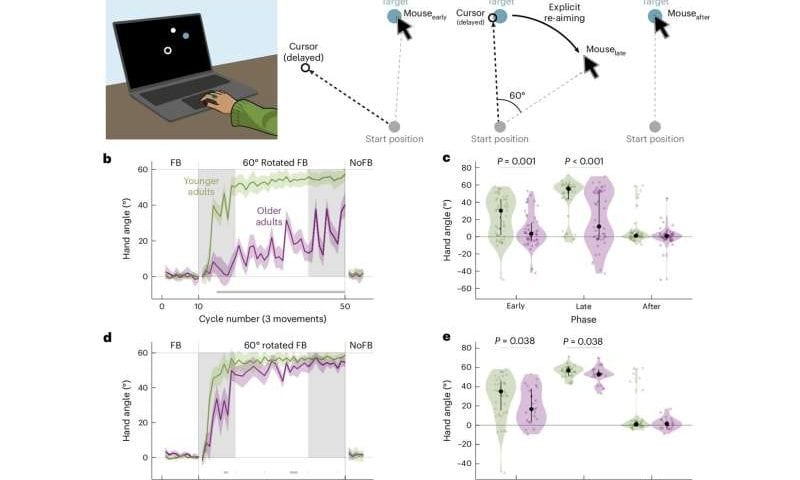
To assess people’s sensorimotor learning skills, researchers typically ask participants to complete simple tasks that entail moving toward a target while what they are seeing is subtly distorted. For example, while participants are moving the mouse to click on a specific object on the screen, the cursor might be subtly rotated, so that it no longer closely reflects the true position of their hand.
“Over time, people learn to compensate for this mismatch,” explained Tsay. “The challenge is that successful adaptation can arise from at least two very different processes. One is implicit recalibration: the nervous system automatically and unconsciously adjusts movements. The other is explicit strategy use: participants consciously discover ways to counteract the perturbation, such as deliberately aiming away from the target.”
Tsay and his colleagues found that most previous studies only assessed people’s overall performance on sensorimotor learning tasks. This made it difficult to determine whether they were relying on explicit or implicit learning strategies.
“To disentangle these systems, we first performed a systematic review and meta-analysis of prior studies,” said Tsay. “We specifically examined measures that could separately estimate overall adaptation versus implicit recalibration. Interestingly, this revealed a striking pattern: older adults tended to perform worse overall, but they showed stronger implicit recalibration.”
Isolating explicit and implicit motor learning
To further explore how explicit and implicit sensorimotor learning change as people age, the researchers designed a new behavioral experiment. Their experiment was specifically designed to isolate the adaptation of skills via explicit strategies from implicit sensorimotor learning.
“For explicit learning, we used tasks that largely suppress implicit recalibration by delaying visual feedback,” explained Tsay. “Under these conditions, participants must rely on deliberate strategies to solve the task.”
The researchers observed that most of the older adults who took part in their experiments struggled to uncover effective strategies to adapt their movements based on visual changes. This effect was particularly evident when the task they were completing required participants to remember specific associations between a stimulus and correct responses.
“For implicit learning, we instead used experimental designs that minimize strategic contributions and instead isolate automatic recalibration processes,” said Tsay. “Surprisingly, older adults consistently showed enhanced implicit adaptation. Together, these experiments revealed that aging does not uniformly impair sensorimotor learning. Instead, aging appears to weaken explicit strategic processes while simultaneously enhancing implicit recalibration.”
A new perspective on motor learning in older age
The results of this recent study challenge existing assumptions and views about how motor learning changes in older age. Instead, it suggests that explicit and implicit movement adaptation processes are affected differently in older adults.
“For many years, the prevailing assumption was that aging broadly impairs adaptation. Our findings show that the story is much more nuanced,” said Tsay. “Older adults are not simply ‘worse learners.’ Rather, different learning systems are affected in different ways.”
Tsay and his colleagues were also surprised to discover that while explicit sensorimotor learning declined, implicit recalibration (i.e., the automatic component of motor learning) tends to improve with age. This finding was confirmed both by their meta-analysis and their new behavioral experiments.
“Importantly, the observed deficits in explicit strategy discovery did not reflect a generalized inability to learn or reason cognitively,” explained Tsay. “Rather, the impairment appeared most pronounced in situations with limited environmental support—contexts in which individuals had to independently discover, maintain, and retrieve effective stimulus–response mappings without rich external cues to guide behavior. In contrast, when the task environment provided stronger structural support for problem solving, older adults often performed comparably to younger adults.”
Notably, the team’s observations appear to support emerging psychological theories of sensorimotor learning. These theories suggest that implicit adaptation is not solely driven by visual error signals, but that it also reflects the integration of numerous sensory stimuli and proprioceptive processes (i.e., people’s sense of their own body’s position in space).
“Because proprioceptive function changes with age, this may alter the way the nervous system computes movement error signals,” said Tsay. “More broadly, these findings may have important implications for rehabilitation and healthy aging. Understanding which learning systems remain preserved—or are even enhanced—could help us design more effective interventions for older adults and patients with neurological disorders.”
Tsay and his colleagues are now planning further studies aimed at further testing their hypothesis and validating their observations. For instance, they would like to determine whether the patterns they reported also emerge in real-world learning environments, outside of laboratory settings.
“Another important direction for future research will involve studying pathological aging and neurological disease,” added Tsay. “For example, we are beginning to investigate how disorders such as Parkinson’s disease and cerebellar degeneration differentially impact implicit and explicit learning systems. We hope this work will ultimately help bridge basic neuroscience with clinical rehabilitation.”