
Methyleugenol is a component of essential oils and is found in basil, tarragon, nutmeg, and fennel. When ingested through food, it can be converted in the liver into a reactive form that induces chemical alterations in DNA. “These so-called methyleugenol-derived DNA adducts have already been detected in human liver tissue,” explains Professor Dr. Jörg Fahrer from the Division of Food Chemistry and Toxicology at the RPTU University Kaiserslautern-Landau. Despite a known potential carcinogenic effect, it has so far been unclear whether and how these types of damage are repaired in human cells.
To address this question, Fahrer’s team investigated various human cell models in which key DNA repair mechanisms had been selectively disabled. In addition, biochemical, cell biological, microscopic, and bioanalytical methods were employed. Scientists from the Division of Nutritional Toxicology at the University of Jena and from the Department of Molecular Genetics at the Erasmus University Medical Center Rotterdam were also significantly involved in the study led by RPTU. The paper is published in the journal Cell Death & Disease.
The researchers were able to show that DNA damage caused by methyleugenol blocks transcription. This is a fundamental process in which genetic information is transcribed from DNA into messenger RNA—an essential step for protein production in the cell. This process is carried out by an enzyme called RNA polymerase II.
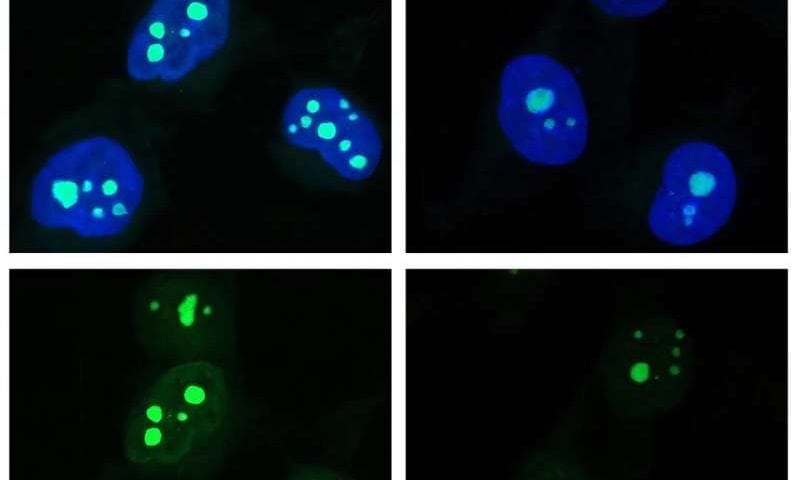
“We visualized the incorporation of newly synthesized, fluorescently labeled RNA building blocks using high-resolution microscopy. This allowed us to observe that methyleugenol-derived DNA adducts lead to a decrease in newly synthesized RNA,” explains Caroline Quarz, doctoral researcher in the Fahrer group and first author of the study. She was supported by Riccarda Walter and Lydia Hens, who completed their master’s theses on this topic and are now also pursuing doctoral research in the group at the Department of Chemistry.
‘DNA reading machine’ blocked—repair mechanism activated
The research team demonstrated that blockage of RNA polymerase II by methyleugenol-derived DNA adducts activates transcription-coupled nucleotide excision repair (TC-NER). In simplified terms, this means that damage caused by methyleugenol disrupts the function of an important “DNA reading machine” in the cell—and this, in turn, triggers a repair mechanism.
This was demonstrated by disabling the genes Cockayne syndrome A (CSA) and B (CSB), which play an essential role in TC-NER. Explaining the background, Fahrer states: “Cockayne syndrome is a rare human genetic disorder caused by the loss of these genes. Affected individuals suffer from premature aging, degeneration of the nervous system, and dysfunction of internal organs such as the liver.”
Indeed, cells lacking CSA or CSB were highly sensitive to methyleugenol-derived DNA damage. This was reflected, on the one hand, in increased genomic instability, as illustrated by the presence of so-called micronuclei—structures outside the cell nucleus that contain genetic material resulting from chromosomal damage. On the other hand, high levels of methyleugenol-induced DNA adducts triggered programmed cell death, known as apoptosis.
Finally, the team showed that methyleugenol-induced DNA adducts are not repaired throughout the entire genome, but instead persist to some extent in DNA. “In the future, we aim to better understand how damage in non-transcribed regions of DNA is tolerated and to what extent it contributes to permanent genetic alterations,” says Professor Fahrer, outlining future research directions.
Relevant not only for patients with Cockayne syndrome (CS)
The new findings are of great importance for individuals with impaired or defective TC-NER, such as patients with Cockayne syndrome (CS). In these individuals, regular consumption of methyleugenol-containing herbs such as basil could lead to a significant accumulation of DNA damage and consequently to liver dysfunction.
In addition, structurally related compounds such as estragole, which are found in food and herbal medicinal products, cause similar types of genetic damage and may further increase liver toxicity in sensitive individuals.
Research on these aspects is ongoing in Fahrer’s group. The overarching goal is to elucidate the underlying toxicity mechanisms to ensure the safety of food products and drugs.