
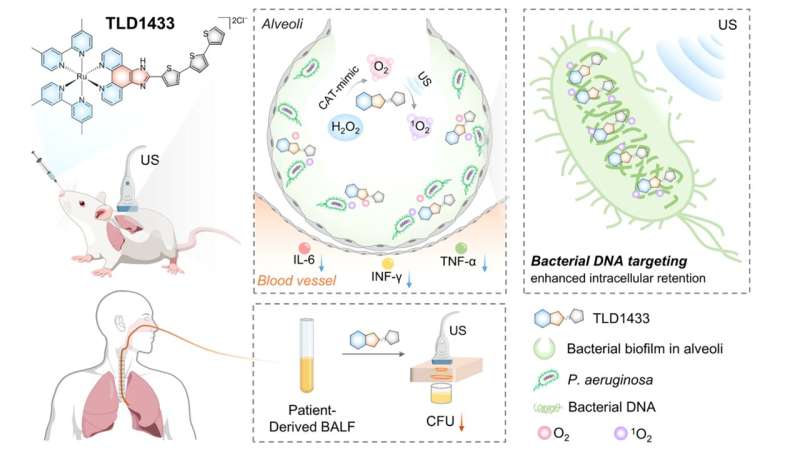
An anticancer medication called TLD1433, a ruthenium(II) complex that has entered Phase II trials for conditions such as non-muscle-invasive bladder cancer, is now being repurposed to address one of the biggest public health issues globally—bacterial infections. Despite being preventable or treatable in many cases, bacterial infections kill an estimated 7.7 million people each year, resulting in one in eight deaths worldwide. With these numbers, it stands as the second-leading cause of death on the planet.
Deep infections are hard to treat because antibiotics and light-based therapies struggle to reach deep enough into tissue, are blocked by the protective biofilms bacteria form around them, and do not work well in low-oxygen environments.
By directing ultrasound at TLD1433, researchers in a recent study turned the drug into a DNA-targeting sonosensitizer that generates large amounts of oxygen species at the site of deep-seated, hypoxic bacterial infections, thereby disrupting vital bacterial functions and killing them.
According to the findings published in the Journal of the American Chemical Society, sound-activated TLD1433 was highly effective at killing bacteria in a mouse model of antibiotic-resistant pneumonia and in lung fluid samples from patients, where treatment is usually more difficult.
Beating the bacterial infection
Ever since the development of antibiotics in the 1920s, the death rate from infections has dropped significantly. At the dawn of the 21st century, however, health care faced the hurdle of antimicrobial resistance, in which pathogens develop resistance to the very medications designed to kill them because of the overuse and misuse of antibiotics, among other factors.
Diseases that were once easily treatable are increasingly becoming life-threatening. One example is lung infection caused by Pseudomonas aeruginosa, a highly challenging bacterium that can resist many antibiotics and form protective biofilms in the lungs.
Scientists have tried methods like photodynamic therapy (PDT), in which light activates drugs that kill bacteria, but this approach has been largely limited by shallow tissue penetration. Then researchers experimented with sonodynamic therapy (SDT), which uses ultrasound (US) for deeper activation. While this could reach the sites, it did not gain traction because of a lack of targeted sonosensitizers.
The researchers in this study found a possible solution in Ru(II) complex TLD1433, which was designed as an anticancer molecule. They used ultrasound, which can penetrate deep tissues, to activate the sonosensitizer drug TLD1433 and first optimized the ultrasound intensity to maximize the production of bacteria-killing molecules.
The next problem most antibacterial medications face is bacteria hidden in biofilms, which create a hypoxic environment that prevents the drugs from working properly.
To overcome this, the researchers designed TLD1433 to act as a catalyst, finding hydrogen peroxide within the infection and breaking it down into fresh oxygen so the treatment works properly.
The team tested the drug-and-ultrasound combination in three different settings: P. aeruginosa, a common cause of pneumonia, and its protective biofilms grown in a laboratory; in mice with pneumonia caused by the bacterium; and in fluid samples from patients with lung infections.
They found that when hit with ultrasound, the drug produced more than 14 times more bacteria-killing reactive oxygen species, outperforming many commercial sonosensitizers.
The drug passes through about 10 centimeters (4 inches) of tissue, allowing it to treat deep infections in the lungs, unlike traditional light-based therapies, which can reach only about 1 centimeter (about half an inch) into the body. They also found that TLD1433 targets bacterial DNA directly, leaving bacteria unable to reproduce or recover.
In mice with severe pneumonia, this treatment resulted in a 100% survival rate and almost completely cleared the bacteria from their lungs within six days. It was equally effective at eradicating bacteria from the collected fluid samples.
The researchers believe these findings could pave the way for a new noninvasive treatment for antibiotic-resistant and deep lung infections, combining a clinically advanced ruthenium complex with a distinct sonodynamic mode of action.
Although promising, the treatment still requires further testing in animal models and clinical trials to determine its long-term safety and effects in humans before widespread clinical use.