
Millions of people worldwide are periodically or chronically affected by gut-related conditions, such as irritable bowel syndrome (IBS), gastroesophageal reflux disease (GERD) and gastroenteritis. Uncovering the physiological and biological processes that contribute to gut health could thus be highly valuable, as it might help devise more effective interventions to prevent and treat these ailments.
The transit of food, fluids and waste through the intestine is known to be coordinated by various interacting systems in the body, including gut wall muscles, neurons in the gastrointestinal tract and hormones. A growing body of research has also been exploring the crucial contribution of bacteria and other microorganisms residing in the digestive tract, which are collectively referred to as the gut microbiome.
Researchers at Boston Children’s Hospital, Harvard Medical School, the University of North Carolina at Chapel Hill and Laval University recently carried out a study aimed at better understanding how these gut microbes interact with specific sex hormones and nerve cells that control the movement of muscles in the intestines.
Their paper, published in Nature Neuroscience, identifies a previously unknown mechanism through which gut microbes influence the peripheral nervous system, regulating the healthy functioning of the digestive tract.
“The colon is an organ in which a lot of different systems in the body converge, including hormones, bacteria, immune cells and nerves,” Meenakshi Rao, senior author of the paper, told Medical Xpress. “To tease apart how these systems interact with each other to regulate how fast things move through the colon (i.e., motility), we used several approaches.”
Probing interactions between microbes, hormones and gut-related cells
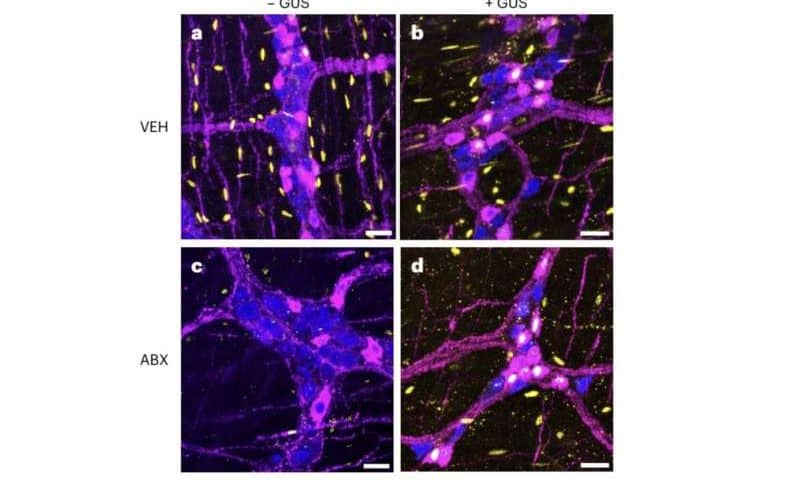
To explore the interactions between gut microbes, hormones and nerve cells, Rao and her colleagues ran a series of experiments involving mice. The researchers dramatically reduced the microorganisms in the mice’s gut using antibiotics, which are known to destroy bacteria in the intestines. They then monitored the animals’ intestinal transit and measured levels of specific hormones called androgens after gut microbes were depleted.
“We used immunohistochemistry to find the different types of neurons and non-neuronal cells that are responsive to hormones like testosterone, antibiotics to deplete bacteria and determine their contributions to both hormone levels and motility, and genetically engineered mice in which we could make different cell types unresponsive to testosterone so that we could learn which ones were most essential for this signaling pathway,” Rao explained.
“When we discovered that bacterial metabolism of inactive hormones was important for this pathway, we then used biological shifts that happen with puberty in the fecal metagenome to identify candidate bacterial enzymes that could mediate this metabolism. We found one that robustly metabolized inactive androgen-glucuronides into their active forms.”
In a series of follow-up experiments, the researchers delivered the microbial enzyme they identified into the colon of mice with a depleted gut microbiome. Remarkably, they found that this enzyme restored androgen signaling among nerve cells that regulate gut movements, which hints at its therapeutic potential.
New insight into the underpinnings of gut health
This study could improve understanding of the biological mechanisms through which gut microbes promote the healthy functioning of the gut. In addition, Rao and her colleagues were able to uncover a promising new therapeutic target for gut-related conditions, which could be further assessed in future research.
“It has long been evident, both from the personal experiences many of us have had and from extensive studies in the scientific literature, that antibiotics cause dysfunction in the digestive tract, but the underlying mechanisms have not been clear,” said Rao.
“This work advances that understanding, showing that peripheral nervous system regulation of an organ’s function—in this case, motor activity in the colon—is regulated by bacterial metabolism of a sex hormone. This not only defines a mechanism by which the nervous system is directly regulated by gut bacteria, but it also reveals that a surprising amount of the host’s circulating level of a sex hormone is dependent on this bacterial activity as well.”
If they are validated in humans, the team’s findings could also potentially inform clinical practices, for instance, by encouraging doctors to prescribe antibiotics only when they are truly necessary. Meanwhile, Rao and her colleagues plan to continue exploring how microorganisms in the gut interact with the nervous system to influence digestive health.
“Our findings imply that short courses of broad-spectrum antibiotics that are routinely used in clinical and veterinary medicine may be disrupting not only nerve function but also sex hormone signaling throughout the body,” Rao added. “They may also explain why patients often develop disorders like IBS after an infection or antibiotic use.”