
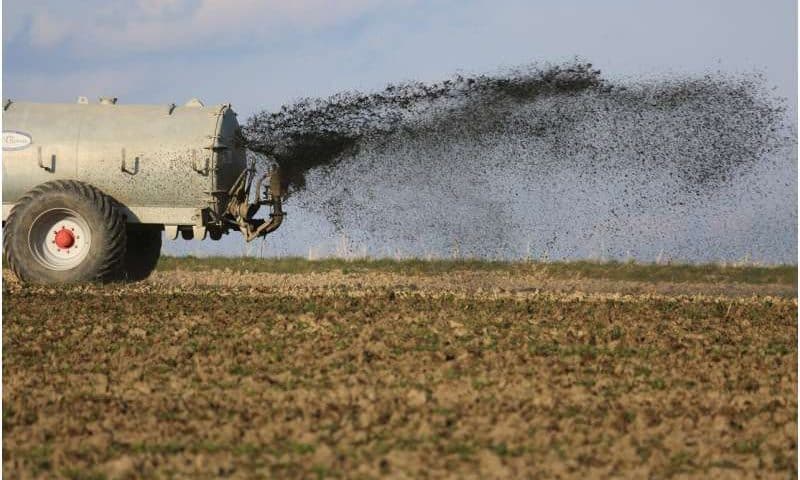
Researchers have uncovered new insights into how phosphorus from recycled materials moves through soil—offering guidance to support more sustainable fertilizer use. Phosphorus is an essential nutrient for plant growth, yet many soils lack enough of it to support strong crop yields. Farmers often rely on fertilizers made from mined phosphorus, a limited, nonrenewable resource.
As global agriculture shifts toward more sustainable practices, researchers are exploring alternative fertilizer recipes made from waste materials. These “recycled” ingredients include sewage sludge (leftover solids from water treatment), sewage sludge ash (from when those leftovers are burned), and meat and bone meal (bones and tissues that are not consumed).
In a study published in Soil Use and Management, researchers from Denmark, Brazil, Germany, Lithuania and Switzerland used the Canadian Light Source (CLS) at the University of Saskatchewan to examine how phosphorus from these recycled fertilizers behaves in different soils over time.
The goal was to better understand when and where this phosphorus becomes available to plants—critical information for improving its effectiveness in agricultural settings.
The researchers used the CLS to identify the chemical forms and precise amounts of phosphorus present in both the fertilizers and soils.
“Phosphorus is one of the most difficult elements in the soil to analyze in a conventional lab,” says Aimée Schryer, lead author of the study and a postdoctoral researcher at the University of Copenhagen.
“It’s hard to make reliable conclusions or recommendations that you can use in the field based on those results; it’s more of a guess.”
“That’s why using the synchrotron was so helpful. It allowed us to discover exactly what’s within our soils and within these recycled fertilizers so that we’re much more confident with our conclusions.”
The team found recycled phosphorus behaves differently from conventional mineral fertilizers. While mineral phosphorus typically becomes less available over time, some recycled sources—particularly those derived from sewage sludge—became more available over time and moved farther through the soil as time passed.
Having the recycled fertilizer move farther through the soil is a significant advantage over mined fertilizer, which normally stays put, Schryer explains. More movement can make the fertilizer easier for plants to access.
The study also found that soil type plays a significant role. Certain combinations of soil and recycled fertilizer improved phosphorus movement and availability, while others limited it, even under favorable conditions.
Overall, the results show that a “one-size-fits-all” approach does not work when it comes to recycled fertilizers. Instead, farmers and researchers must consider both the type of soil and the timing of application to maximize effectiveness.
Using advanced tools at the CLS allowed the team to better understand the different forms of phosphorus present—information that is essential for making accurate predictions about how these fertilizers will perform.
This research represents an important step toward reducing reliance on mined fertilizers and advancing a more circular agricultural system, in which waste materials are reused productively.
Schryer says that while field studies are an important next step, her team’s findings will help inform future research and the development of practical recommendations for farmers.