
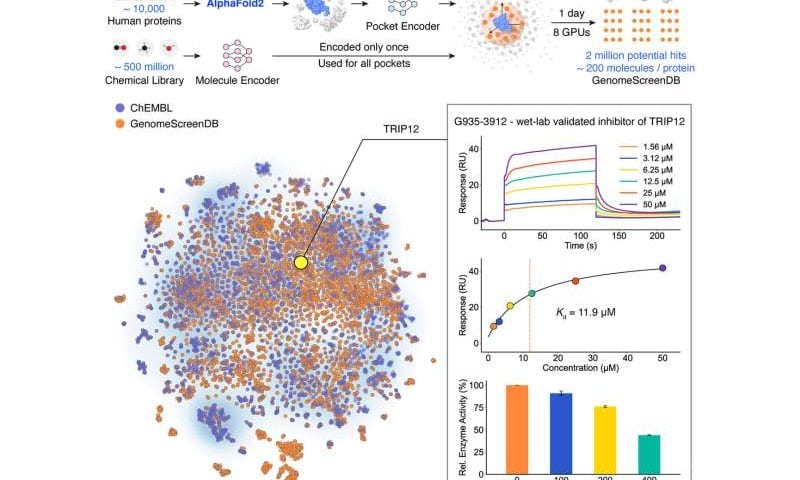
Researchers in China have unveiled a new AI framework that could accelerate the discovery of new medicines. DrugCLIP can scan millions of potential drug compounds against thousands of protein targets in just a few hours—ten million times faster than current virtual screening methods.
Typically, when scientists develop new medicines, they use complex computer simulations to fit a 3D drug molecule into a protein pocket. This indicates that it is likely to interact with the protein’s binding site and function. However, the process is incredibly time-consuming and expensive.
Different approach
So Yanyan Lan at Tsinghua University and colleagues decided to take a different approach to drug discovery, as they describe in a study published in the journal Science. Instead of slow physical simulations, DrugCLIP works like a high-speed search engine.
The program uses two neural networks, one for the protein pocket and one for the molecule. It trains them to convert both components into mathematical vectors, and if there is a fit, these will be close to each other in a shared digital space.
The AI only needs to measure the distance between the vectors to find a match. By turning the physical shape of a potential drug into numbers, the system can search through trillions of possibilities instantly.
To make this work for thousands of targets at once, the team used another AI program, AlphaFold 2, to predict the 3D structures of about 10,000 human proteins. This shows how proteins curl into the 3D shapes they need to work.
However, while the computer-generated shapes are generally correct, the pockets where a drug needs to fit often lack sufficient detail. So the researchers created GenPack, which makes the pockets accurate enough for DrugCLIP to find a match.
Superfast
In tests, the AI engine scanned targets representing roughly half of the protein-coding human genome. It matched 500 million potential drug molecules against 10,000 protein targets, completing 10 trillion scans in one day. DrugCLIP also found a matching molecule for TRIP12, a protein linked to cancer and autism. It had previously stumped scientists because its structure wasn’t well understood.
“DrugCLIP is an ultrafast virtual screening method that we rigorously validated through in silico benchmark evaluation and wet-lab experiments,” commented the scientists in their paper.
“Its speed enables trillion-scale screening covering the human druggable proteome, providing an open-access resource that forms a foundation for next-generation drug discovery, particularly for less understood targets.”
DrugCLIP and the database of 10,000 proteins are freely available, so scientists around the world can use them to search for new medicines.