
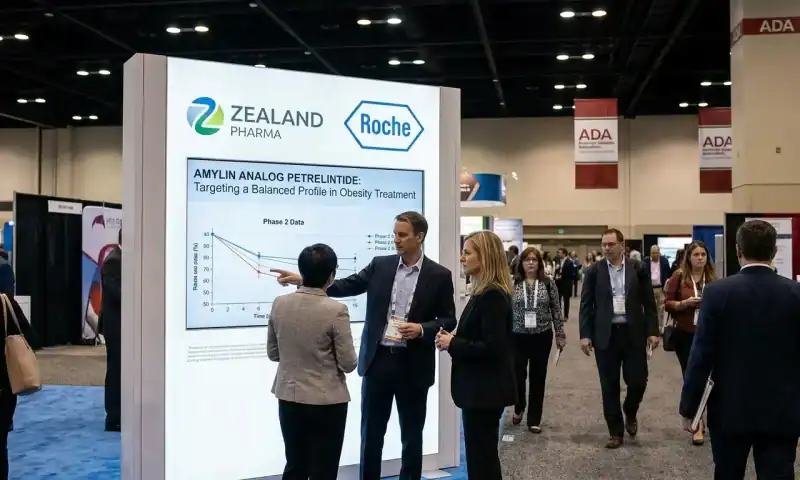
Analysts and investors were unimpressed by Phase 2 data posted in the spring showing that an amylin analog developed by Roche and partner Zealand Pharma elicited 9% weight loss, less than Eli Lilly’s rival candidate. Executives from both companies told BioSpace that premium weight loss is not the point of petrelintide.
Mid-stage data from Roche’s Zealand-partnered amylin analog may not have met analyst expectations, but they met Roche’s.
Petrelintide generated 9% weight reduction at 42 weeks in the Phase 2 ZUPREME-1 study, Roche and Zealand reported in March—disappointing investors who had anticipated at least 12% weight loss, William Blair said at the time. Petrelintide’s result also fell short of Eli Lilly’s rival amylin candidate eloralintide, which achieved about 16% weight loss in a Phase 2 trial.
Manu Chakravarthy, global head of Cardiovascular, Renal and Metabolism Product Development at Roche/Genentech, offered a different perspective.
“Respectfully, I would disagree with the analysis, because it doesn’t really take into account the totality of what it is that we’re trying to do,” Chakravarthy told BioSpace ahead of the 2026 American Diabetes Association conference in New Orleans.
Zealand CEO Adam Steensberg similarly rejected the narrative that there’s no place for petrelintide in the increasingly fragmented weight loss market. Both companies say the focus needs to be on what exactly patients want—and their drug has it.
“We are absolutely certain that if you put the medium- to long-term light on, then people come to realize that the world doesn’t need more effective tools, they need tools that people can actually adhere to, tools that people can stay on,” Steensberg said in a call with BioSpace on the sidelines of the ADA conference in New Orleans.
Finding the sweet spot
Roche’s obesity portfolio is designed to focus on unmet needs more broadly, Chakravarthy said.
“We know that obesity is a complex, recurring, heterogeneous disease. It’s a chronic disease, so we know that it needs extended duration of time of therapy, oftentimes the whole life of an individual,” he continued. “When we look at it from that lens . . . we have to be able to meet the patients wherever they are in that journey, and that requires a portfolio of solutions.”
With petrelintide, Roche and Zealand are not striving for 20% weight loss, Chakravarthy said. “We already have such an agent,” with enicepatide, a dual GLP-1/GIP receptor agonist currently in Phase 2 studies.
One of the unmet needs Roche and Zealand are seeking to address is tolerability. In ZUPREME-1, the company aced it, with no more patients dropping out due to side effects in the highest petrelintide dose arm than in the placebo group.
“If you move into double-digit weight loss with placebo-like tolerability, that is what we would consider the sweet spot for any first-choice medicine, because it is what most people actually tell you that they’re looking for,” Steensberg said.
Steensberg, for one, is not interested in taking a second-line position behind Eli Lilly and Novo Nordisk. He thinks petrelintide will serve as a first-line option for patients who want to lose about 10% of their weight without difficult side effects.
“Why would you not try to start your weight loss journey on this product?” he said.
Petrelintide is also a different modality than the market-leading GLP-1s, providing differentiation, Steensberg added. “Remember, we are only four years into the treatment of obesity, which is the biggest healthcare challenge of our time,” he said. “We are four years in. We have two tools that are quite similar. We don’t have the toolbox.”
At ADA, the companies will present late-breaking data from ZUPREME-1 highlighting the injection’s efficacy and safety.
Next up, Roche and Zealand are moving petrelintide into Phase 3, with a study expected to begin in the second half of the year. Steensberg promised a “robust” program that focuses on quick access to the market. The companies will then do a Phase 3b to build on that evidence.
“This is not just yet another GLP-1,” the CEO said. “This is a new class, which we have to build.”
Roche’s GLP-1/GIP gears up for Phase 3
Roche will also present detailed data on the Phase 2 trial of enicepatide, which elicited placebo-adjusted weight loss of 22.5% after 48 weeks in the CT388-103 trial.
Chakravarthy said that, as a clinician, two aspects of the data stood out, with the first being the weight loss threshold.
“The reason why that’s important is because we know that when you achieve certain thresholds of weight loss, you actually unlock significant health benefits,” such as reversal of diabetes and other comorbities associated with obesity, he explained. In the Phase 2 trial, Chakravarthy said, 26% of participants lost more than 30% of their weight, and almost 40% shed 25% or more of their weight.
The second point that stood out to Chakravarthy was the proportion of trial participants who no longer met the definition of obesity (a BMI over 30) after 48 weeks of treatment. More than half of the participants who began the trial in this category were no longer considered to have obesity by the end of the study.
“That’s from a population health perspective, now you’re starting to see whether we can actually bend that curve in a meaningful way,” he said.
As for safety, 5.9% of patients discontinued the trial due to adverse events compared to 1.3% in the placebo arm, according to Chakravarthy.
Enicepatide is currently in two Phase 3 studies as a standalone treatment, and a mid-stage trial combining enicepatide and petrelintide is slated to begin in the second half of this year.