
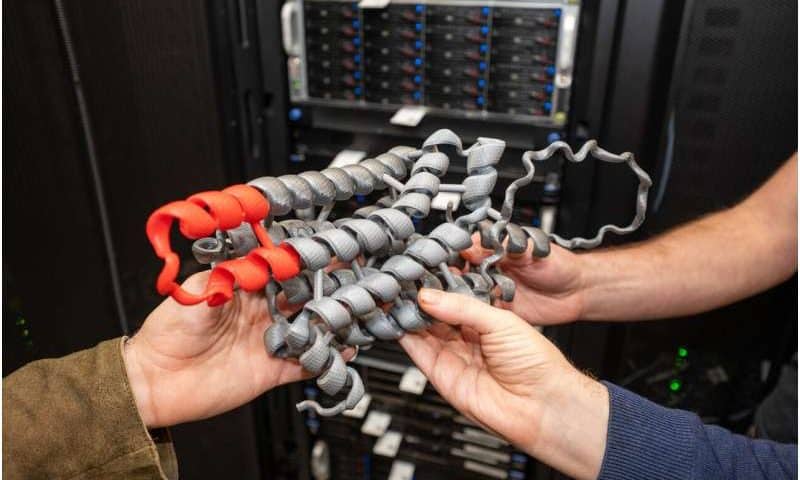
Researchers at the University of Pennsylvania have developed ApexGO, a novel, AI-powered method for turning promising but imperfect antibiotic candidates into more potent ones. Unlike many existing AI approaches to antibiotic discovery, which screen large databases for molecules that might work, ApexGO starts with a small number of imperfect candidates and improves them step by step, using a predictive algorithm to evaluate each modification and guide the next.
“Antibiotic discovery is fundamentally a search problem across an enormous molecular space. ApexGO gives us a way to navigate that space with far more direction,” says César de la Fuente, Presidential Associate Professor in Bioengineering and in Chemical and Biomolecular Engineering in the School of Engineering and Applied Science, in Psychiatry and Microbiology in the Perelman School of Medicine and in Chemistry in the School of Arts & Sciences.
He is co-senior author of a new paper describing the method in Nature Machine Intelligence.
“ApexGO begins with a promising but imperfect peptide,” explains de la Fuente, referring to a short string of amino acids, “proposes precise edits, predicts whether those changes are likely to enhance antimicrobial activity, and then keeps moving toward versions that are more likely to work when we make and test them.”
Laboratory tests against disease-causing bacteria supported ApexGO’s predictions: 85% of the AI-generated molecules halted bacterial growth, while 72% outperformed the peptides from which they were derived. In mice, two antimicrobial peptides created by ApexGO reduced bacterial counts at levels comparable to polymyxin B, an FDA-approved antibiotic used as a last-resort treatment for some drug-resistant infections.
“What is striking is that ApexGO’s predictions held up in the real world,” says Jacob R. Gardner, Assistant Professor in Computer and Information Science (CIS) and the paper’s other senior co-author.
“ApexGO was optimizing against another computer model, so one concern was that it might find molecules that looked good to the model but failed in the lab. Instead, the majority of the molecules it designed actually worked.”
From screening molecules to making new ones
For years, the de la Fuente lab has looked for antibiotic candidates in unlikely places, from frog secretions to ancient microbes. Two years ago, the group released APEX, an AI model that predicts whether or not a given peptide is likely to have antimicrobial properties.
“APEX helped us find promising antibiotic candidates in enormous biological datasets,” says Marcelo Torres, Research Assistant Professor of Psychiatry in the Perelman School of Medicine and co-first author of the paper, referring to work that revealed antibiotic candidates everywhere from woolly mammoths to giant sloths.
“ApexGO takes the next step: once we have a promising molecule, it helps us ask how to make it better.”
That’s where Gardner’s lab comes in. The group specializes in methods like Bayesian optimization, which helps AI systems explore large numbers of possible solutions efficiently.
“It would be impossible to test every possible peptide,” says Yimeng Zeng, a doctoral student in CIS and co-first author of the paper.
“Bayesian optimization helps the model make informed choices about what to try next, balancing candidates that look promising with candidates that could teach the model something new.”
Essentially, one part of ApexGO—short for APEX Generative Optimization—suggests molecular tweaks, while the previously published APEX model predicts whether those changes are likely to increase antimicrobial activity. ApexGO then uses those predictions to guide the next round of proposed edits.
“If a region of the search space looks promising, the model can spend more effort exploring nearby variants,” says Zeng. “But it can also move into less certain regions, where there may still be hidden improvements.”