
Past research has found that exposure to bright lights and high levels of noise can alter both physiological processes and human behavior. For instance, an elevated or limited exposure to bright lights and noise has been found to influence people’s sleeping patterns, circadian rhythm, mood, metabolism, stress levels and mental performance.
Researchers at Jinan University and other institutes in China recently carried out a new study involving mice, exploring the possibility that the exposure to bright lights also influences eating behavior and body weight. Their findings, published in Nature Neuroscience, suggest that bright light exposure suppresses food consumption in mice and can lead to weight loss, while also identifying neural processes that could support these light-induced changes in feeding behavior.
“Environmental light regulates nonimage-forming functions like feeding, and bright light therapy shows anti-obesity potential, yet its neural basis remains unclear,” wrote Wen Li, Xiaodan Huang and their colleagues in their paper. “We show that bright light treatment effectively reduces food intake and mitigates weight gain in mice through a visual circuit involving the lateral hypothalamic area (LHA).”
The effects of bright light on feeding behavior
Light is known to play a crucial role in various physiological processes, including sleep, the release of hormones and eating patterns. Bright light therapy (BLT), which entails exposure to intense artificial light for 30 minutes or more daily, is already used to treat various mental health disorders, including seasonal affective disorder (SAD), insomnia and depression.
Recent studies have found that BLT could also facilitate weight loss or prevent weight gain. The neural mechanisms via which light could influence eating behaviors and weight, however, have not yet been clearly elucidated.
To investigate these mechanisms, Li, Huang and their colleagues performed an experiment involving adult mice. The mice were divided into two groups, an experimental and a control group.
All the mice were exposed to light for 12 hours per day, while they spent the remaining 12 hours in darkness. During the 12 hours of light, however, the mice in the experimental condition were exposed to light of varying intensities (~0, 1,000, 3,000 or 5,000 lux).
The researchers observed the mice’s behavior and tried to understand how light influenced activity in their brains using chemogenetic techniques. These are methods that allow neuroscientists to control the activity of specific brain cells, by genetically altering cells in ways that prompt responses to specific chemicals.
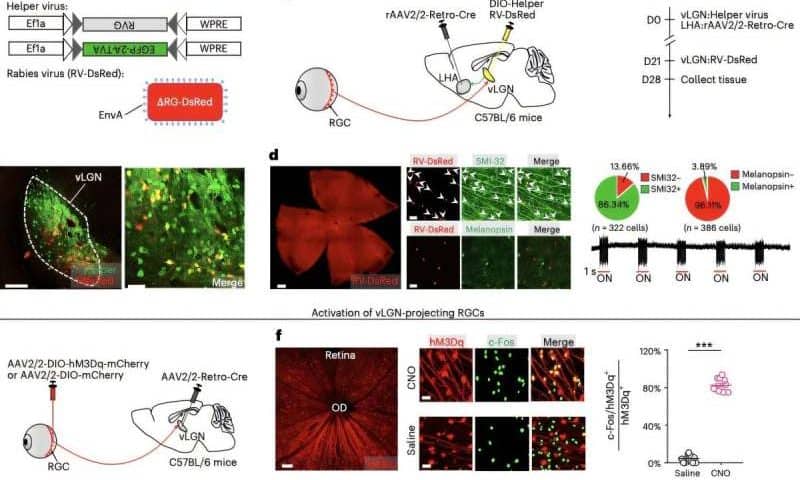
The team observed that if exposed to bright light, mice consumed less food and gained less weight. They were also able to identify a neural circuit that appeared to be responsible for this effect, which involved neurons in two different brain regions.
“Specifically, a subset of SMI-32-expressing ON-type retinal ganglion cells innervate GABAergic neurons in the ventral lateral geniculate nucleus (vLGN), which in turn inhibits GABAergic neurons in the LHA,” Li, Huang and their colleagues wrote. “Activation of both vLGN-projecting retinal ganglion cells and the vLGN-to-LHA projection is sufficient to suppress food consumption and attenuate weight gain.”
Possible implications for obesity interventions
This recent study offers a possible biological explanation for the previously reported effects of bright light exposure on food consumption and body weight. Other researchers could soon build on the team’s findings and set out to further investigate the newly identified vLGN-LHA pathway, to better understand its contribution to feeding behavior.
“We provide direct evidence that the suppressive effects of bright light treatment on food consumption and weight gain rely on the activation of the retina–vLGN–LHA pathway,” wrote the authors. “Together, our results delineate an LHA-related visual circuit underlying the food consumption-suppressing and weight gain-attenuating effects of bright light treatment.”
In the future, the results gathered by Li, Huang and their colleagues could inform the development of new light-based interventions aimed at preventing obesity, helping people to maintain a healthy weight or even facilitating weight loss.