
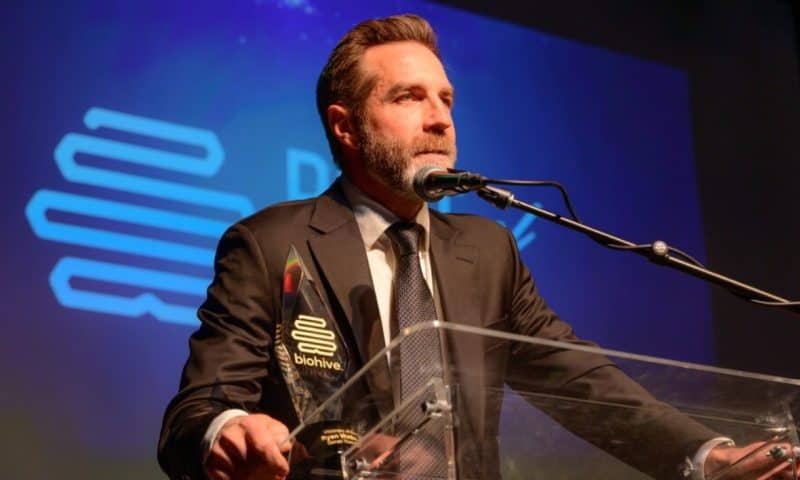
After receiving the FDA’s greenlight for Hunter syndrome drug Avlayah, Denali Therapeutics CEO Ryan Watts saw the culmination of 20 years of hard work unraveling the mysteries of the blood-brain barrier.
After walking out of the Denali Therapeutics war room to announce that the Utah-based biotech’s Hunter syndrome drug had been approved by the FDA, CEO Ryan Watts had a call to make.
Months ago, while at home on his ranch outside of Salt Lake City, Watts had received an email from the mother of a patient with the devastating lysosomal storage disorder that typically claims the lives of patients by age 20. Denali’s tividenofusp alfa had been delayed at the FDA by three months, and time is critical in Hunter.
“My son needs your medicine right now,” the mom told Watts. “There can’t be any more delay.”
After reading the email, Watts remembers his wife saying, “This is a lot. You’ve been going after this for 20 years. This is really hard.”
So when tividenofusp alfa finally got the greenlight on March 25, cleared to launch under the brand name Avlayah, Watts knew he had to call that mother—even if he was speechless in the moment.
“It was the greatest professional moment of my life,” Watts said on Thursday, as he accepted an award from Utah’s biotech community hub, BioHive.
Water under the bridge
Watts told the same story to BioSpace on the sidelines of BioHive Live in Salt Lake City last week, reflecting on the accomplishment his company had just achieved.
The last year of Avlayah’s journey to the market was dramatic, but the drug actually began the march 20 years earlier. Watts, a scientist by training, previously served as director of the neuroscience department at Genentech, helping steer the innovative Roche unit back to the brain. His lab there focused on solving the mysteries of the blood-brain barrier to improve the passing of medicine into this critical organ.
This work, coincidentally, began in 2006, the same year the only previous drug for Hunter syndrome drug was approved, Watts told BioSpace. Since then, the Hunter syndrome community has been waiting for something better—a therapy that truly targets the brain and extends the lifespan of boys with the disease.
Hunter syndrome attacks around age two or three, robbing boys of milestones they’ve already achieved, like talking and walking.
Watts left Genentech to form Denali 11 years ago, beginning the slow work of building a brain delivery system called the TransportVehicle that could one day anchor a therapeutic like Avlayah. The biotech focused on lysosomal storage disorders because many already had approved enzyme therapies that simply weren’t getting into the brain.
Avlayah arrived at the FDA’s door in July 2025, an auspicious time for a rare disease therapy to be submitted to the agency. Throughout the year, the regulator had been battered by massive layoffs, infighting among leadership and public disagreements over how to handle therapies with clinical trials that were not straightforward.
The application was based on a Phase 1/2 study of 47 patients—a single-arm study, like the kind that has drawn the FDA’s scrutiny for many companies over the past year. Denali in February 2025 reported a normalization of key biomarkers associated with Hunter syndrome, plus long-term safety data showing that the drug was well tolerated over two years.
The application was accepted without incident, granted priority review and set for a decision on January 5. In the meantime, Denali began staffing up the launch team, readying to have product available to deliver to patients as early as the end of 2025.
Then, the other shoe dropped. In October 2025, the FDA delayed the application by three months.
Watts said the delay was based on a “clerical error.” A molecular weight had been incorrectly added to a datasheet by a third-party provider, which resulted in a miscalculation. The FDA’s crack team caught it. The error was fixed within four days, but the delay was already in place.
For all the concerns around regulatory delays and other challenges coming out of the FDA, Watts credits the team that reviewed Avlayah for their thorough work. The process was “clear, linear, rigorous.”
“I think it was fine. That’s water under the bridge,” Watts said, reflecting on the moment that drew the email from the patient’s mother.
And in the end, the drug was approved.
“We were so ready to go,” Watts said. “Product was manufactured, ready to go the second we got the label approved.” The process to get a drug into the market channel actually takes about two weeks—but Watts said Denali made sure everything that could have been done ahead of time was ready. “Boom, printed it, and it’s now in channel,” he added. The company is currently working through reimbursement of the product with insurers as patients work on getting their prescriptions.
“A lot of rare disease launches have this S-shaped curve, and the challenge is making sure you get reimbursement to basically start the medicine, and that’s a process,” Watts said.
Asked if anyone had been cleared for reimbursement and had been treated with Avlayah at this point, Watts said, “Stay tuned.”
Proof of concept
The CEO hopes that Avlayah’s approval can help assuage some concerns for the broader rare disease community. He’s well aware that, while Avlayah was approved, peer company REGENXBIO was not as lucky with its gene therapy RGX-121.
Watts declined to speak to exactly what could have gone wrong with REGENXBIO’s application, which was rejected by the agency on February 9, but pointed out that the two companies are working on two completely different mechanisms of action. Avlayah also showed clear improvements in key biomarkers. “That is different than what any other medicine has shown,” he said
Instead of arriving on the Hunter market behind REGENXBIO, Denali now has clear sailing as the first new medicine for the condition in 20 years.
“Avlayah represents the first FDA-approved medicine using this mechanism to get large molecules into the brain,” Watts explained. “And for us, it’s actually just the beginning.”
Analysts heralded the Avlayah approval as proof of Denali’s delivery concept. The company has big plans for its platform, with programs lined up in Sanfilippo syndrome, Pompe disease and Alzheimer’s. Meanwhile, a partnership with Biogen is targeting Parkinson’s disease.
“Obviously rare disease is very important for us, but really, we’re built around technology to get medicines into the brain,” Watts explained.
A rare disease like Hunter is a perfect proving ground for not only Denali’s technology but also the company’s goal to be a standalone commercial biotech. The indication is small, with about 500 patients in the U.S. But once additional medicines for other indications are added, Denali will be able to lean on the same workforce and tap similar clinicians to launch quickly.
Denali’s work in Hunter isn’t done yet, either. Watts noted that the FDA label currently only covers children, and he knows adults want access too.
“There’s a lot of celebration, but there’s always work to be done,” he said.
Denali has also recently taken back the rights to the TREM2 agonist drug DNL919 for dementia from Takeda. The two companies began working together in 2018 on three programs, which covered a broad swath of the dementia space across three different targets using Denali’s TransportVehicle technology.
The two tau TREM2 programs met with early challenges, as rival companies saw no clinical benefit with the target but detected amyloid-related imaging abnormalities (ARIA), a side effect common to modern Alzheimer’s drugs, Watts explained. ARIA can indicate bleeding or swelling in the brain. Denali and Takeda’s tau programs were shelved as the prospects dwindled and preclinical data suggested futility.
The progranulin program for frontotemporal dementia (FTD) remained, and while promising, Watts said it would only help about 5% of the dementia community. With 50/50 profit sharing, the revenue just wasn’t enough for Takeda to continue. Denali, on the other hand, is set up to work in smaller, rare disease areas, so the FTD program is a nice fit.
“The challenge is, when you’re working with a big partner like Takeda, it makes perfect sense to work on TREM2. It makes perfect sense to work on tau,” Watts said. “If you’re successful in Alzheimer’s, it’s a huge commercial potential.”
The Denali CEO understands Takeda’s decision—as the larger pharma has been doing a major pipeline reorganization—but is keen to see the DNL919 program through.
This FTD program will be a part of Denali’s next act after Avlayah, which Watts envisions moving into more common diseases. Partnerships may happen, but Watts is committed to turning Denali into a major standalone biotech.
“At Denali, our ultimate goal is to discover, develop and deliver medicines, and going after rare and ultra rare diseases, you can actually do all three. And the goal is that whatever revenue just feeds back into discovering more medicines,” Watts said. “In the next 20 years, we’d love to be able to look back and now we have multiple medicines that we’re commercializing.”