
To ensure a robust domestic supply chain in the U.S., Lawrence Livermore National Laboratory (LLNL) scientists are using bacterial proteins to separate the rare-earth elements that are ubiquitous in magnets, batteries, and electronics. These proteins, called lanmodulin, evolved in bacteria that use rare-earth elements to power their metabolism. But to scale up and advance biomining technology, researchers need a faster way to find and design better proteins.
In a recent study, published in Nature Chemical Biology, a team at LLNL invented a high-throughput platform that screens proteins for their rare-earth element binding preferences at an unprecedented scale. The result, supported by the Defense Advanced Research Projects Agency (DARPA) through its Environmental Microbes as a BioEngineering Resource (EMBER) program, enables the first large-scale picture of how protein sequence relates to metal selectivity in lanmodulins.
This new technique—called SpyTag-Catcher Immobilization of Lanmodulin for Assaying Metal-Binding Selectivity (SpyCI-LAMBS) and pronounced “spicy lambs”—drastically cuts the time required for these experiments and enables data collection that can be used to train machine learning models for protein design.
“It only took about a month to collect 600 proteins’ worth of data with this new assay,” said LLNL scientist and first author Patrick Diep. “It would have taken three to five years with the usual process.”
Previous methods were laborious. Researchers ordered custom DNA, transferred it to E. coli bacteria to produce the protein, and then extracted the proteins from the bacteria cells. But there are over 4,000 different types of proteins contained within that “protein soup,” so they had to purify the single protein of interest from all the others.
“We started by just saying, ‘one by one, let’s go through these lanmodulin proteins and test them.” We made it through a handful of them and realized it would take us the rest of our lives to effectively characterize them all,” said LLNL scientist and senior author Dan Park.
In contrast, SpyCI-LAMBS can skip all purification steps, making it possible to characterize the entire family of lanmodulin proteins. Right away, the new platform made an impact.
“We found versions of the protein that were better than what we knew before going in,” said Park. “That has practical implications for rare-earth element separation. One of those proteins is now a major focus of applied research going forward.”
The team discovered eight distinct clusters of lanmodulin proteins with different rare earth element binding preferences, including one cluster of more than 200 protein variants with improved selectivity against light rare-earth elements. Some new proteins were able to complete traditionally challenging rare-earth element separations in a single step.
SpyCI-LAMBS works based on two biomolecules that bind and stay together like a two-sided button that permanently snaps into place. The team adds one side of the button, the SpyTag, to the lanmodulin protein’s DNA, then produces that protein in a small well within their test platform.
Separately, they stick the other side of the button, the SpyCatcher, onto glass beads.
“If you add SpyCatcher glass to each of these wells, you can immediately, directly immobilize all of that SpyTagged protein onto the surface and ignore everything else,” said Diep. “If you produce the protein with the SpyTag partner for the SpyCatcher, it will automatically snap onto the beads.”
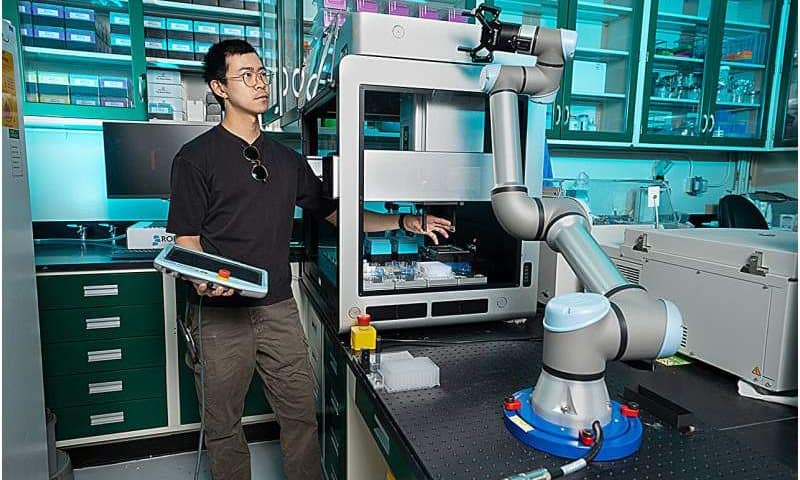
With 96 wells containing 96 different lanmodulins tagged and locked in place, the researchers can simultaneously screen their metal selectivity against a panel of rare-earth elements. They are able to run multiple 96-well blocks in parallel and are currently working to automate the process with robotic systems.
To ensure the accuracy of measurements from SpyCI-LAMBS, the LLNL team collaborated with researchers at The Pennsylvania State University to perform detailed validation of select protein variants. This validation is important not only for process development but also for advancing the fundamental understanding of how lanmodulin proteins achieve metal selectivity. The team found a relationship between a protein’s amino acid sequence and rare-earth element selectivity, and that differences in selectivity may reflect important differences in physiology or ecology of microorganisms with lanmodulin proteins.
The wellspring of new data from this platform is being used to train machine learning algorithms to predict how a given protein will bind to rare earths. Once trained, the model can suggest proteins with similar or different capabilities, enabling the design of entirely new proteins with tailored metal selectivity.
“By transforming metalloprotein characterization from a low-throughput bottleneck into a scalable data-generation platform, the approach opens the door to predictive, data-driven design of metal-selective proteins,” said LLNL scientist and co-author Yongqin Jiao.
And SpyCI-LAMBS is not limited to lanmodulin proteins or rare-earth elements. In theory, the method could examine any protein for the ability to bind to any element, and the researchers aim to expand their work into other critical metals.
“What I love about this approach is it reduces the cost of failure, so you can try some pretty wild ideas,” said Park. “We often throw in all kinds of different designs and concepts. And sometimes they work, sometimes they don’t, but the point is that we can afford to test these ideas now.”