
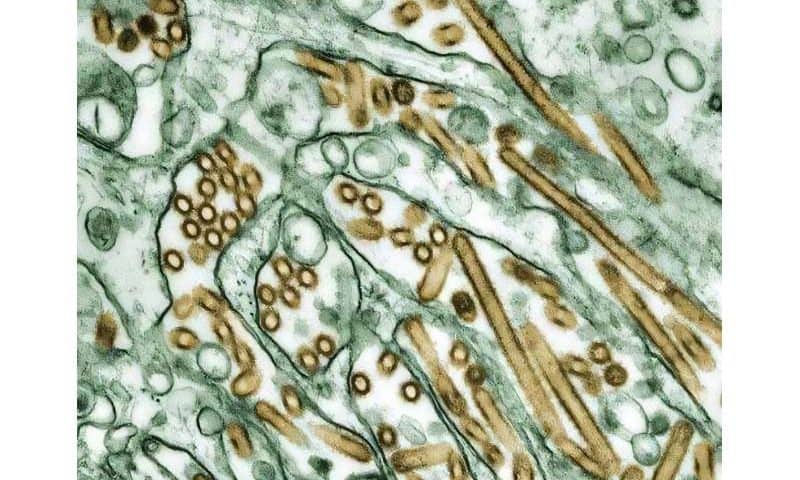
At this point, avian flu H5N1 is thought to have very limited ability to transmit between humans, but a recent case in British Columbia with an unknown source of transmission has piqued the curiosity and concern of scientists, including York University Professor Seyed Moghadas. Did this lone case come about through transmission from an animal or another person, and if it was via human transmission, what methods would control its spread in the human population?
Director of York’s Agent-Based Modeling Laboratory in the Center of Excellence in AI for Public Health Advancement, Moghadas and a group of researchers used modeling to understand the best spread control measures should human-to-human transmission become possible.
“The idea was, let’s evaluate some of the interventions that we usually implement at the very earliest stage of a disease outbreak or emerging disease, which we know very little about,” he says.
For the research, “Containment Scenarios for Post-Spillover Transmission Chains of Avian Influenza H5N1 from Poultry to Humans,” published in Nature Health, various scenarios from isolation to vaccination before or after a spillover event were modeled.
It is one of only a few studies that have explicitly modeled outbreak dynamics following spillover into humans or the effectiveness of public health interventions in early and highly uncertain phases of virus development.
As a professor of computational epidemiology and vaccine science in York’s Faculty of Science, Moghadas and his colleagues were already collecting data on H5N1 cases in the United States when the Canadian case arose. Given the unknown nature of transmission, the team decided to pivot their work to look at what was happening in B.C.
“The case in B.C. was of particular interest to us because no definitive source of exposure was identified, including no direct contact with infected animals or known high-risk settings such as poultry farms,” says Moghadas. “Because of that, it came to our attention that maybe there is some sort of transmission going on between humans.”
As far as health and science experts know, H5N1 can only be transmitted among poultry and dairy cattle on farms, as well as through wild birds, and from these animals to humans, but sustained human-to-human transmission has not been established.
The person from B.C., however, had no clearly identified exposure and even though human infection from animals is rare, avian influenza H5N1 is considered highly pathogenic and a potentially serious and evolving threat to global public health.
“This virus was first identified in 1997 in Southeast Asia. This kind of zoonotic virus essentially jumps from the bird or animal side to human side sometimes, mostly it circulates among wild birds,” says Moghadas. “There is no confirmation that human-to-human transmission happens as yet in North America.”
The virus has only been in North America since 2022, but surveillance monitoring for it began in 2003 and up until recently there have been close to 1,000 cases reported globally in humans and just under 500 deaths, although the number of cases could be higher because not all cases are likely reported or symptomatic. The virus has not only expanded its geographical range, but also the animal species it can infect.
“Evolution of influenza viruses of any type is always a challenge for humans. The flu virus is one of the very rapidly mutating pathogens,” he says. The concern is it will mutate to be able to transmit between humans. How viable is it? How easily can it spillover from animals to humans, and how long could the potential chain of transmission from human-to-human become? These are still open questions.
“Quantifying that risk was important for us because that could also give us direction in terms of how bad the disease could be and what strategies will work to contain it,” says Moghadas. “We have very few measures in place or a strategy to deal with it at this point, given that the transmission between humans is not established.”
As it is an avian flu virus, it will likely require two doses of a similar vaccine to what was used during the H1N1 pandemic to reduce the risk and severity which often triggers a higher viral load.
The researchers used Abbottsford, B.C. as the location as it is a highly dense poultry farming area. The starting point is after a spillover has happened.
“If a human becomes infected, how do we block this single individual to trigger a large outbreak? Or if the infection is going on between humans, can we block these chains and to what degree can we block them?” asks Moghadas. “What is the effectiveness of either self-isolation of symptomatic cases or vaccination of farmers or vaccination of farmers and their household members?”
Even with mitigation measures, someone in the farmer’s family could potentially be infected by the farmer and then transmit it to someone in the community.
The team evaluated two different types of vaccination strategies. One was reactive, which means that you trigger a vaccination program after a case has been identified somewhere. The second strategy was pre-emptive—individuals, such as farmers, are vaccinated before any case is identified.
What they found is that reactive vaccination has very limited additional benefits outside of self-isolation, but pre-emptive vaccination adds substantial additional benefits on top of self-isolation.
Should the virus be confirmed to be capable of human-to-human transmission, Moghadas says they want to limit the chain of transmission and minimize the risk of evolution of the virus to become more adapted to human conditions.
For now, he says, when cases are identified, the person should self-isolate immediately. For the authorized vaccine, it should be meted out quickly to target populations, but that could take several weeks to have population level effectiveness.
“Timely action is a critical part of controlling the spread. Self-isolation of symptomatic cases has a significant effect, but that comes with the caveat that we don’t know if everybody who is infected will develop symptoms,” says Moghadas.
“There could be potential asymptomatic cases we don’t identify and by the time we do identify them, they’ve already been infecting others in the chain of transmission. This case in B.C. was particularly concerning because they could not find the source of infection.”
The concern is not only that the virus might be able to jump from animals to humans, but also the potential for it to mutate during early human transmission chains, making it more adaptable to infecting humans. This underscores the risk of local outbreaks with global implications, he says.
“My research is all about evidence generation for governments, health-care providers and policymakers in public health organizations. We are generating evidence that can be used to at the very least limit the potential for this virus to become another pandemic,” says Moghadas.