
Researchers, including those from the University of Tokyo, have successfully grown large tomatoes and cherry tomatoes, both rich in nutrients, in tightly controlled environments where the light source was energy-efficient LEDs. Such methods were often limited by the types or sizes of plants that could thrive in such conditions.
A feasibility study, published in HortScience, demonstrates the researchers’ method is suitable for urban environments, potentially even in space, and can offer food security in the face of climate change or extreme weather conditions.
Pizza, pasta, soup, salad, the tomato really is a versatile and delicious food crop. Its delicious and nutritious nature comes with a cost though; it has a very high demand for light, as well as water.
While tomatoes grow well in some parts of the world, there are many regions where the local climate is not ideally suited to them, and with climate change exacerbating weather and the environment, having a way to improve yields or enable cultivation at all has long been sought.
Greenhouses are the main method for creating a controlled environment suitable for growing crops, including tomatoes, but they have drawbacks and still rely on natural sunlight, which can be a limiting factor in some areas. If you’ve ever bought greenhouse-grown tomato soup in Iceland, for example, you may have realized this all too well.
There has been some research and even agricultural use of artificial light plant factories (ALPFs), which are exactly what they sound like: fully controlled environments tailored to specific crops to maximize yields without compromising on other factors. These have a proven track record but require a lot of power to operate due in part to the lighting they require.
A logical step is to use energy-efficient LED lights, which have been successful for certain crops such as leafy greens, but nothing more substantial. Spinach and lettuce are nice, but they’re no slice of pizza.
Realizing this limitation, Associate Professor Wataru Yamori from the Graduate School of Agricultural and Life Sciences at the University of Tokyo and his team decided to refine this concept to make it bear fruit.
“Plant factories are resilient to climate extremes such as droughts, floods and heat waves that increasingly disrupt traditional farming. They can be built in deserts, cities, or one day even in space. By bringing production closer to consumption, they help reduce both climate risk and food transport needs,” said Yamori.
“For many years, people assumed that crops with relatively long cultivation periods that require high light intensity, such as large-fruited tomatoes, could not thrive under LEDs. Our earlier work proved that cherry tomatoes, and even edamame, could be grown in such systems. Testing large tomatoes was the next logical challenge, pushing the boundaries of what plant factories can do.”
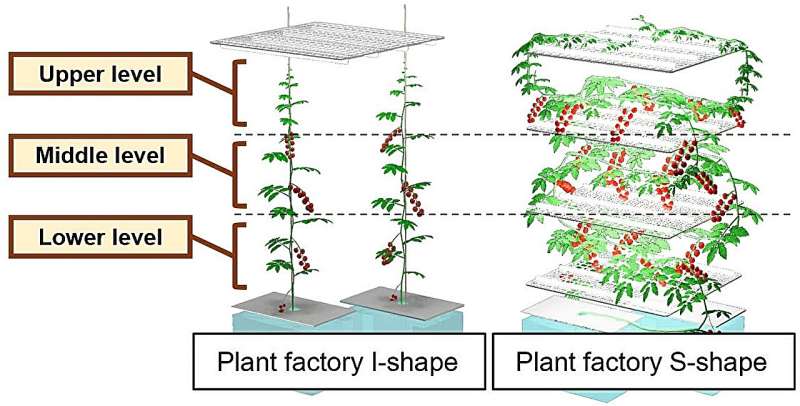
The team did more than just change a few lightbulbs for LEDs though. They first fit an enclosed factory space with the standard materials necessary for growing tomatoes, but introduced different lighting setups, both using high-efficiency LEDs, depending on which variety of tomatoes they were growing.
Over the course of a year, they lit large-fruited tomato plants from above, coaxing them to grow straight upwards as you’d expect. But the second setup involved lighting smaller cherry tomato plants from either above or from the sides, in such a way that they grew upwards in an S-shaped series of bends.