
Yawning is incredibly contagious, and more often than not, seeing someone yawn right in front of us makes us instinctively do the same. It is often tied to social and emotional connection and brain mirroring, where we automatically align and simulate the emotions and actions of the people around us. A recent study published in Current Biology has found that this behavior begins even before birth.
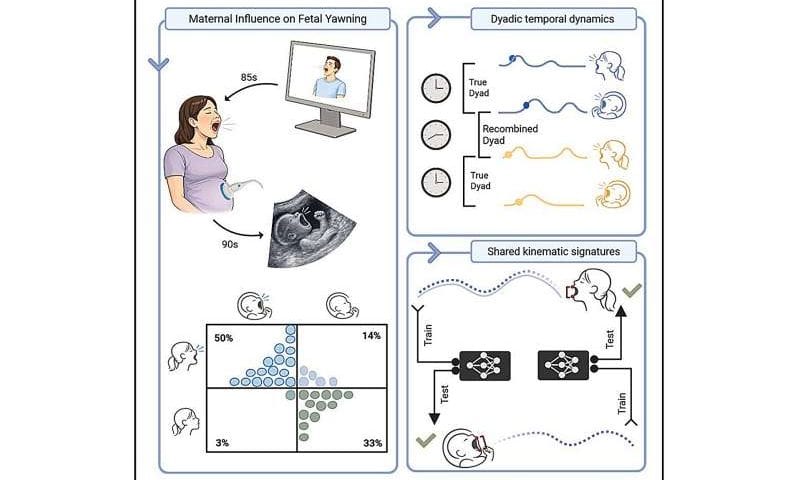
Researchers recorded the facial expressions of pregnant women while an ultrasound machine captured real-time images of their fetuses’ faces. By comparing the two recordings, the researchers observed that fetuses were more likely to yawn after their mothers yawned, with a delay of about 90 seconds.
Tracking mother–fetus yawn sync
Yawning in humans begins far earlier than most people realize. Fetuses start yawning in the womb at around 11 weeks of development. Since there is no air for the fetus to draw in, during a yawn, they slowly open their mouths, perform movements that resemble breathing in and out, and then gently close their mouths again. For a long time, scientists believed that fetal yawning was thought to be driven purely by internal biological processes, but there wasn’t enough evidence to prove it either right or wrong.
In this study, the researchers wanted to see if fetuses in the womb would catch a yawn from their mothers. For this, they recruited 38 pregnant women who were between 28 and 32 weeks along, all with healthy, uncomplicated pregnancies.
The experiments involved the mothers watching three different types of video in a quiet room: a yawning video, a mouth-movement video, and a still-face video. While a video camera monitored the mother’s face, the researchers used a 2D ultrasound machine to provide a real-time view of the fetus’s nose and lips.
Three experts, who didn’t know what the mother was watching, reviewed the collected footage and verified the yawns. The researchers used an AI tool called DeepLabCut to precisely track subtle lip and nose movements, then trained a neural network to see whether a mother’s yawn mirrored the movement pattern of her fetus’s.
The researchers found that fetal yawning increased significantly only when the mother yawned, not when she simply opened and closed her mouth or kept her face still. They called this phenomenon prenatal behavioral contagion. The fetal yawns were not random either; they typically appeared about 90 seconds after the mother yawned, which is similar to the response time seen in contagious yawning among adults.
These findings suggest that fetal yawning may be part of an early mother-baby connection, where a mother’s behavior can influence how the fetus responds. Further research into how deeply this behavioral connection works, and whether it has long-term developmental effects, could reshape prenatal care.