
Computational chemists at the University of Amsterdam’s Van ‘t Hoff Institute for Molecular Sciences have developed a comprehensive software suite to create accurate models of DNA in biomolecular assemblies. Called MDNA, the user-friendly molecular modeling toolkit helps biochemists, molecular biologists, bioinformaticians, and biophysicists to visualize and analyze DNA structures and perform accurate simulations.
The development of the MDNA suite, led by associate professor Jocelyne Vreede, has been presented in a paper in Nucleic Acids Research.
The software is open-source and publicly available through Figshare and Github. It is easily accessible, providing inspiration to any scientist with an interest in DNA. It has been thoroughly tested by students in mathematics, chemistry and biology, some of whom had hardly any programming experience.
Structure generation
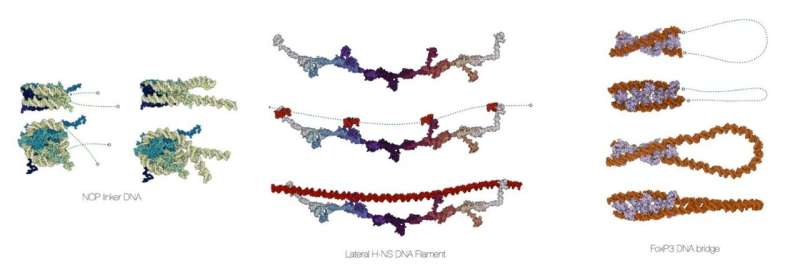
MDNA supports molecular simulations by providing atomic resolution structural modeling of double-stranded DNA in diverse shapes and compositions, including DNA-protein assemblies. By facilitating precise structural modeling of DNA at atomic resolution, MDNA contributes to improving the understanding of DNA dynamics and interactions in complex biological systems.
With MDNA, users can easily generate coordinates for the atoms in double-stranded DNA. It represents each base pair as a rigid body, according to the rigid base formalism of the Curves+ code, already a popular tool for analysis and visualization of three-dimensional nucleic acid conformations.
MDNA allows users to create DNA coordinates in many different forms on any arbitrary curve in three-dimensional space. Users can create DNA strands or modify and extend existing structures. It comes with a library of sixteen bases that will be expanded in the future.
The Amsterdam researchers collaborated with the group of Helmut Schiessel at TU Dresden (Germany), implementing an energy function to equilibrate the generated structures and ensure that physical properties of DNA, such as stiffness and mobility, are modeled correctly.
This does not need to explicitly include all atoms, which enables rapid equilibration within seconds. The energy function also includes constraints that can introduce supercoiling into the DNA.
A single workflow
In addition to generating structures, the software library offers the ability to analyze existing DNA structures, for example from MD simulations. By integrating structure generation and analysis into a single workflow, MDNA facilitates the study of DNA-protein interactions, supporting new insights into DNA dynamics and molecular simulations.
To support users at various levels of molecular modeling, MDNA is complemented by tutorials and demos. These resources improve accessibility for novice and experienced users, providing a starting point for educational applications such as workshops or classroom demonstrations.