
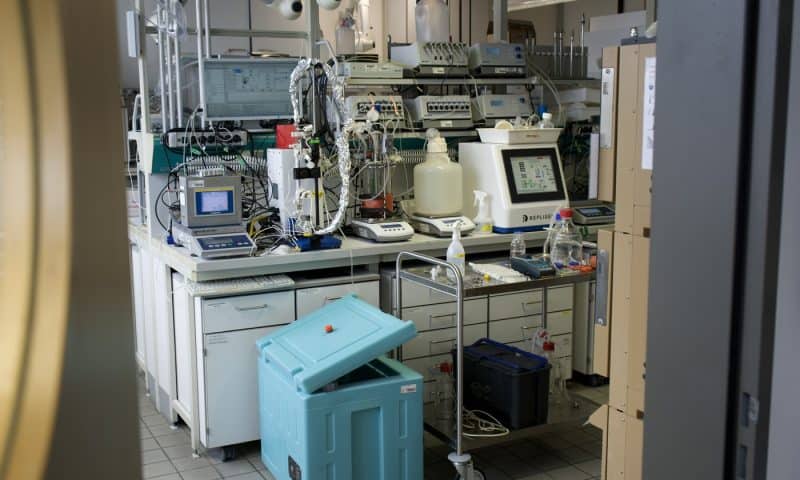
Researchers based in Germany have developed a perfusion process for the manufacture of oncolytic viruses. The team from the Max Planck Institute says that the new approach aims to improve virus titers as well as the sustainability of processes while helping patients receive effective therapy.
“Oncolytic virus therapies are an interesting way to treat cancer, but these therapies need quite high input doses,” explains Lennart Jacobtorweihe, a doctoral researcher in upstream processing at the Max Planck Institute. “The current state-of-the-art manufacturing is through batch processes, often using adherent cells, but it is lacking in terms of the virus titers that can be achieved.”
To overcome this issue, the scientists developed perfusion processes using suspension cells designed to produce different types of oncolytic viruses at high cell concentrations while maintaining the cell-specific productivity of a batch process.
Perfusion is nothing new in bioprocess engineering, according to Jacobtorweihe, but oncolytic viruses can be more challenging for manufacturers using continuous processes because they can have a half-life of only a few hours at typical temperatures of 33–37°C.
To overcome this short half-life while running a four-day process, the team adopted technologies such as a tangential flow depth filtration system Repligen. They found that they could harvest viruses and cool them during manufacturing, reducing losses compared to a traditional batch process.
The Max Planck group also adapted stirring speeds, temperatures, and multiplicity of infection for multiple types of oncolytic viruses and their respective cell substrate, Jacobtorweihe explains.
“There are many types of cancer, so we need different treatments, and we need to adopt all the process parameters because each virus is not a copy-paste of what was [developed and] published before,” he says.
The researchers are now moving on to testing different viruses, along with pushing cell concentrations from the current 20 million cells per milliliter to closer to 100 million cells.
“We want to understand the limits of the cell retention viruses and processes, and see if we can get a five-fold higher titer of virus,” points out Jacobtorweihe.