
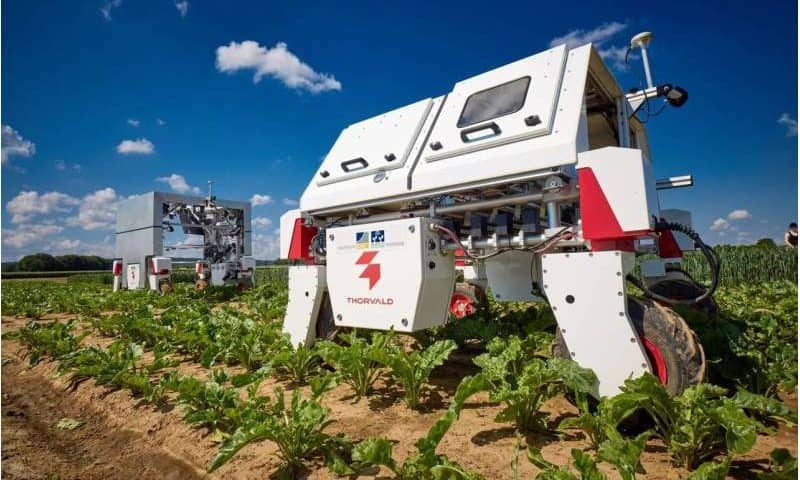
The agricultural industry may be producing more food than ever before, but it is also damaging the climate, harming the soil and eroding biodiversity.
A team of researchers from the PhenoRob Cluster of Excellence at the University of Bonn has published a paper in the journal Agricultural Systems that explains the key role technological innovations will need to play to make agriculture sustainable in the future and why these will have to be accompanied by shrewd policies and new business models.
What the research is about
Humanity is now producing more food than at any time in its history. The agriculture sector urgently needs to be made more sustainable, however, because the solutions that have increased its productivity throughout the past few centuries are also causing environmental problems in the form of climate change, biodiversity loss, soil degradation and water pollution.
One of the main reasons for this is that people are seeking individual solutions for each problem rather than actually planning the innovation process. The result is that these isolated solutions never produce any new systems in the agriculture sector except under the guiding hand of policymakers.
YA vision for a more sustainable agricultural system
Instead of numerous individual innovations, we need a unified system of innovation that’s geared toward a vision shared by the whole of society. The first thing to do is decide what sustainable agriculture needs to look like, which will determine suitable technologies, business models and policymaking rules.
It’s important to get all the stakeholders on board and consider both opportunities and risks at an early stage in order to foster areas of potential and avoid negative side effects.
In a paper published in the journal Agricultural Systems, researchers indicate how such a rot-and-branch transformation of Europe’s agriculture industry can succeed.
The biggest challenges facing agrotechnology
By far the biggest challenge is to make sustainable agricultural technologies attractive enough for farmers to invest in them. There’s a lot that can be done from a purely technical perspective, but there’ll never be widespread take-up of new technologies if they’re less profitable than existing ones while also being risky to boot.
In other words, policymakers need to create the right environment: strengthening environmental regulations that make environmentally harmful technologies less profitable, increasing the agri-environmental payments that create a financial incentive for green entrepreneurship and forming broad coalitions—especially partnerships with industry—to create new markets and leverage synergy effects.
How policy guidelines need to change
Policy should be made more ambitious but also more straightforward. There’s great discontent among farmers, because there’s too much micromanagement and red tape. Society wants more sustainability, but not at the expense of affordable food. European countries are currently having to invest large sums in a great many areas, such as defense and the energy transition.
So we need policies that are extremely effective while also delivering value for money. And the timing is propitious, because there’s now some high-quality underlying data available—from satellite measurements, drones and sensors on board agricultural machinery—coupled with advances in machine learning and causal inference. It’s never been easier to get a faster and more comprehensive idea of what works, what doesn’t and why.
Five risks of smart farming explained
The first risk is the widespread belief that digital, automated agriculture is automatically more environmentally friendly. Although smart farming offers a lot of opportunities, the innovations it brings can also harm the environment depending on how they’re used. The second risk is that power and profits get concentrated in the hands of a few large corporations.
New technologies could leave small businesses facing a tougher time and accelerate structural change in the agriculture sector. Third, there’s the danger of poor or misguided policymaking. If they’re guided mainly by what’s easy to measure rather than what’s really important, then policy steps might miss the mark.
The fourth risk is that new technologies don’t work as intended. Innovation needs experience and learning, and mistakes will sometimes happen. Plus, technical systems—such as AI-powered robots—can also make the wrong decisions. The fifth risk, and one that’s particularly important, is that technical solutions squeeze out other necessary changes.
New technologies aren’t sufficient on their own to solve the major environmental problems facing agriculture. Less attention risks being paid to mindful consumption or other changes to people’s behavior, for example, if too much hope is being invested in technology.