
For decades, neuroscientists have been trying to pinpoint the neural underpinnings of behavior and decision-making. Past studies suggest that specialized groups of neurons in the mammalian brain, particularly in the cortex, work together to support decision-making and behavioral choices.
Some cortical neurons project to specific regions in the brain. This essentially means that they send axons, projections that transmit electrical impulses from one cell to another, to other areas.
Some neuroscientists have hypothesized that neurons projecting to the same area form specialized “population codes,” coordinated activity patterns that collectively represent specific information.
Researchers at Harvard Medical School and University Medical Center Hamburg-Eppendorf (UKE) carried out a study involving mice aimed at testing this hypothesis and shedding new light on how this process unfolds.
Their findings, published in Nature Neuroscience, suggest that neurons in a region of the mouse brain, the posterior parietal cortex, which project to the same area, do in fact form specialized population codes. These codes were in turn found to be associated with the mice making correct decisions in behavioral tasks.
“Cortical neurons projecting to the same target area may form specialized population codes to transmit information, but whether and how they do so remains unclear,” Houman Safaai, Alice Y. Wang and their colleagues write in their paper.
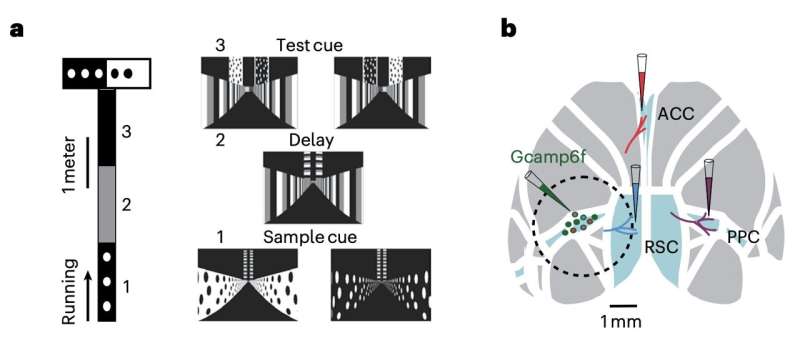
“We used calcium imaging in mouse posterior parietal cortex, retrograde labeling and statistical multivariate models to address this question during a delayed match-to-sample task in virtual reality.”
Exploring how neurons work together to guide decisions
To conduct their investigation, the researchers employed a combination of techniques, including calcium imaging, retrograde labeling and multivariate statistical models.
Calcium imaging is an experimental tool that can be used to track activity in specific regions of the brain, utilizing fluorescent indicators that light up when neurons fire. Retrograde labeling, on the other hand, is a technique to mark neurons based on where their axons end, and multivariate statistical models are analysis tools that can uncover interactions between several variables.
During the team’s experiment, the mice completed a memory-guided task that required them to choose how to behave within a virtual reality (VR) environment. The researchers tracked how the interactions between the mice’s cortical neurons changed when they made correct and incorrect choices.
“We found that neurons projecting to the same area have elevated pairwise activity correlations,” write Safaai, Wang and their colleagues. “These correlations are structured as information-limiting and information-enhancing motifs that shape interaction networks and collectively enhance information about the mouse’s choice beyond what is contributed by pairwise interactions.”
Probing the neural roots of decision-making
When they analyzed the data they collected, the researchers found that patterns of synchronized activity between neurons projecting to the same region predicted correct behavior. These neurons were found to form a network-like structure that made it easier to predict if the mice acted “correctly” in the VR-based task.
“This network structure is unique to subpopulations that project to the same target and was not observed in surrounding neural populations with unidentified projections,” write the authors.
“Furthermore, this structure is only present when mice make correct, but not incorrect, behavioral choices. Therefore, cortical neurons comprising an output pathway form a population code with a unique correlation structure that enhances population-level information to guide accurate behavior.”
This work could contribute to the understanding of how cortical neurons work together to guide choices and behavior. Future studies could further investigate the emergence of population codes observed by the researchers and its implications for decision-making.