
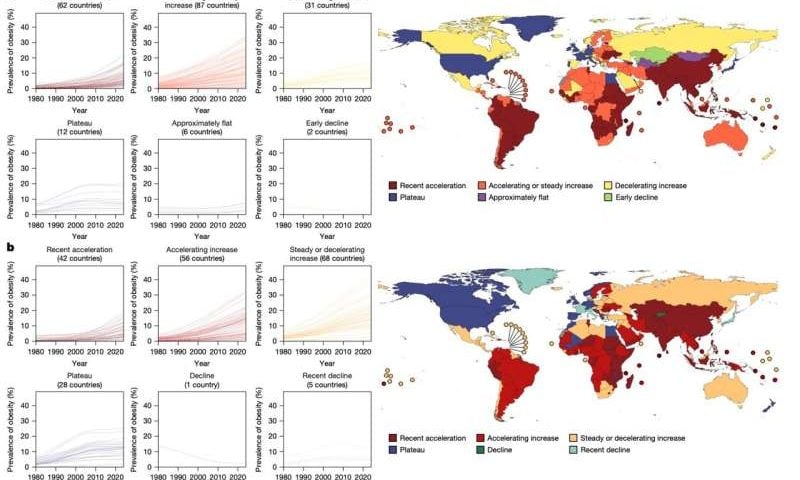
Obesity has long been the invisible health crisis looming over humanity, with rates climbing globally. There is some positive news now emerging from a multi-decade study spanning several nations. A recent study published in Nature by the Non-Communicable Disease Risk Factor Collaboration (NCD-RisC), a global network of health scientists, analyzed obesity-related data from 232 million people aged 5 years or older, spanning 45 years.
The data revealed that obesity trends may finally be slowing in many high-income Western countries, including Western Europe, North America, and Australasia, as well as in some high-income Asian countries, with several showing signs of plateauing and even slight declines, particularly among children and adolescents.
The picture across low and middle-income countries tells a far more alarming story. Childhood and adolescent obesity is not only rising, but accelerating rapidly in parts of Asia, Africa, Latin America, the Caribbean, and the Pacific Islands.
Obesity beyond weight
Nearly 1 in 8 people is living with obesity, which equates to more than 1 billion people, making this non-communicable disease nothing short of an epidemic.
Several long and short-term studies conducted across the world have found that obesity is far more than a weight issue. It can quietly make the way for a wide range of serious health conditions, increasing the risk of heart, kidney, liver, and respiratory diseases. It is also linked to musculoskeletal disorders affecting the muscles, bones, and joints, which in turn can affect quality of life. The dangers of obesity became even more evident during the COVID-19 pandemic, where individuals with obesity faced a significantly higher risk of severe infection, leading to greater rates of hospitalization and even death.
Even though it sounds counterintuitive, obesity is considered malnutrition, which by definition refers to deficiencies, excesses, or imbalances in a person’s intake of nutrients. However, nutrition and how much one exercises aren’t the only factors driving obesity.
The factors differ from country to country and continue to change over time due to shifts in food production, processing, and other influences on food prices and availability. It is also influenced by economic factors, such as living conditions, social habits, and the kind of food policies created by the government.
Global or local?
Most global obesity reports focus on long-term trends and overlook the smaller year-by-year shifts that reveal how the crisis is evolving. They also failed to closely track how obesity patterns differ across countries, age groups, and shorter time periods.
In this study, researchers analyzed data from 4,050 population-based studies conducted between 1980 and 2024 across 200 countries and territories. They aimed to build a detailed year-by-year picture of global obesity trends, so instead of simply measuring how many people were obese at a given point in time, they tracked the annual pace at which obesity rates were rising or falling.
Using a computer-based pattern-recognition technique called clustering, the researchers also identified distinct phenotypes, or groups of countries that shared similar obesity patterns across children, adolescents, and adults.
The results exposed an emerging global divide in the obesity crisis. In many of the world’s richest countries, obesity rates are beginning to stabilize, but across several developing nations, the crisis is accelerating at an alarming pace. In high-income countries, obesity rates in children and teenagers began to slow as early as the 1990s; in adults, a similar trend began around 2000.
Access to healthy food and health information may have helped slow rates in wealthier countries. In developing nations, urbanization, transition from physically demanding to sedentary work, and dependence on imported processed foods might have quietly changed how people live, and unfortunately, public health systems failed to keep up.
These findings show that the global obesity crisis is far from uniform. So, the researchers argued that obesity cannot be considered a single global epidemic, as trends vary widely across the world. Some countries are stabilizing, others are still seeing rapid rises. This makes it quite evident that the obesity crisis can no longer be addressed with a one-size-fits-all approach. To combat this, we need more tailored policies and public health education programs.