
A new tool makes it possible to screen millions of tiny protein fragments and select those that can be recognized by the immune system. The CIC biomaGUNE Center for Cooperative Research in Biomaterials has developed epiGPTope, a system that uses machine learning to generate and classify epitopes, in collaboration with the company Multiverse Computing.
The immune system is triggered by the presence of viruses or bacteria. When the antibodies produced recognize the epitopes, a small part of these viruses or bacteria, they launch an attack strategy. These epitopes are small fragments of protein recognized by antibodies or by immune cell receptors. So discovering new epitope sequences that target specific antibodies is essential for the development of diagnostic tools, immunotherapies and vaccines.
CIC biomaGUNE’s Biomolecular Nanotechnology laboratory, led by the Ikerbasque Research Professor Aitziber L. Cortajarena, is creating a library or database of hundreds of thousands of synthetic epitopes using this AI-based technique. The work is published in the journal ACS Synthetic Biology.
This method for creating biologically viable sequences enables the research group to generate and select synthetic epitopes more quickly and cost-effectively, as well as to classify them according to their viral or bacterial origin, thereby facilitating their application in biotechnology and biomedicine.
“From among millions of possible combinations, we identify synthetic epitopes that are very similar to natural epitopes, and which can be recognized by antibodies,” explained Aitor Manteca, a research associate in the group. The aim is “to see what applications these molecules might have in medical research, drug development and biotechnology.”
“What is more, we are able to determine whether an epitope comes from a bacterium or a virus.” That way, “a rational library of epitopes comprising hundreds of thousands of units rather than hundreds of millions, which are stored in the laboratory” can be built. “These are physical collections of molecules for experimentation purposes,” he added.
Devices for point-of-care diagnosis
However, these epitopes do not remain confined to small test tubes. Real-world applications are being sought for them. Once this initial screening has been carried out, the protein fragments are analyzed using microfluidic systems.
This is technology “that allows a single epitope to be tested against a specific antibody in a highly precise, rapid and cost-effective manner, yielding numerous results in a short space of time,” explained Manteca.
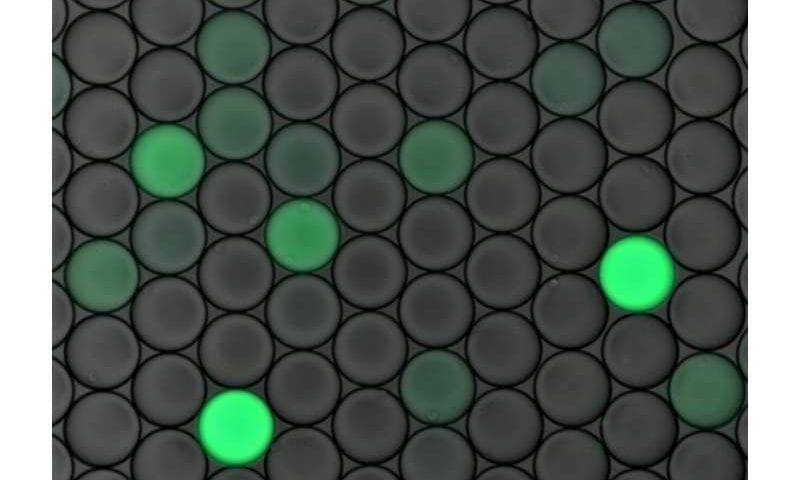
Microfluidics allows the experiments to be carried out on tiny droplets, which act as individual reactors, thus using very small quantities of molecules. “It is possible to analyze millions of different combinations simultaneously within a short period of time,” added the CIC biomaGUNE researcher.
“So it is possible to find out in advance “which sequences will trigger an immune response and drive forward, for example, the development of diagnostic techniques and new point-of-care devices capable of measuring the presence of a bacterium or virus in the body, blood, water, and so on,” explained Dr. Aitor Manteca.
These developments are particularly relevant for transfer to the industrial sector, as in the case of the enterprise Taldeki Biosolutions, which uses a detection technology licensed by CIC biomaGUNE. In this context, the capacity to rapidly and rationally generate and select epitopes means that the identification and validation of recognition elements to be integrated into new sensors can be significantly sped up.
This approach is expected to have a direct impact on the development of advanced diagnostic solutions, because the rapid development and selection of epitopes will enable the scope of these sensor technologies to be significantly expanded to cover a wide range of detection applications.
This encompasses not only the biomedical field, but also environmental and biotechnological contexts by strengthening the link between fundamental research and industrial application.
The use of machine learning algorithms and artificial intelligence is revolutionizing every field in which it is applied. Biotechnology is no exception; in fact, one could say that bioinformatics is one of the first fields to adopt many of the new technologies currently being developed.
CIC biomaGUNE is streamlining the building of a collection of hundreds of thousands of molecules and the study of their potential applications in medicine, pharmacology and biotechnology.