
With plastic pollution at an all-time high, the need for biodegradable materials has never been higher. Most packaging is “single use” and is made from sources, like natural gas, that take hundreds of years to decompose in the environment. This is greatly contributing to the plastic pollution buildup in parks, street corners and shelterbelts.
At South Dakota State University, associate professor Srinivas Janaswamy has been exploring ways to solve this problem by creating materials that mimic plastic packaging. Known as “films,” these plastic-like materials are made from natural sources—like coffee grounds, banana peels and soybean hulls—and unlike traditional plastic, will naturally decompose in the environment.
In this Q&A, Janaswamy discusses his latest research published in Biomass and Bioenergy and explains the potential “waste-to-wealth” opportunities in the agricultural sector.
How did you first become interested in this research?
My interest in this research began with concern about plastic pollution and its long-term effects on the environment and human health. Plastics are durable and convenient, but they persist for centuries, breaking down into microplastics and nanoplastics that are now found in ecosystems and even in the human body. This raised an important question for me: Can we develop more sustainable alternatives?
At the same time, I became interested in agricultural biomass—materials like crop residues, food waste and processing byproducts that are often overlooked or discarded as low-value resources. These materials are rich in cellulose, a renewable and biodegradable polymer with strong potential to replace conventional plastics.
“Agricultural biomass is often just an untapped resource.” This idea became the foundation of my work. I began developing biodegradable films from materials like alfalfa, soyhulls, wheat straw and discarded fruit peels. What motivates me most is that these films are not only sustainable but also functional—they can even help extend the shelf life of fresh produce.
Describe the science behind your work.
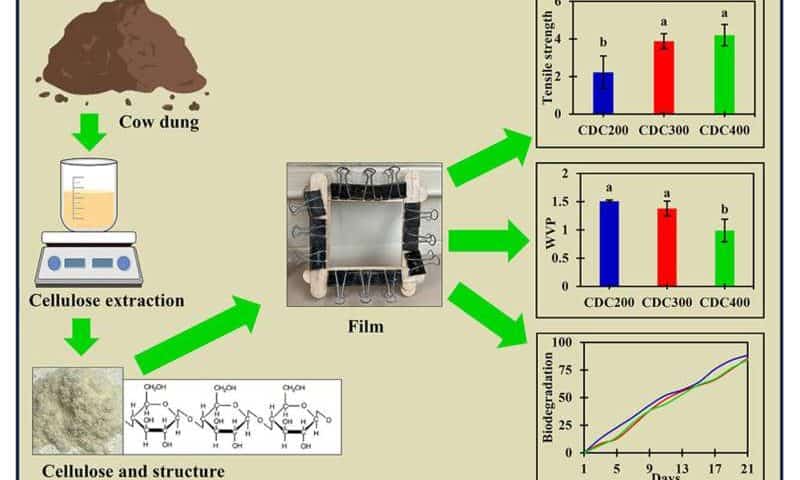
Our research focuses on transforming agricultural byproducts into biodegradable films using cellulose, a natural polymer found in plant cell walls. Although cellulose is abundant and strong, it is tightly bound within plant structures, making it difficult to use in its raw form. To address this, we extract cellulosic material from biomass through a series of chemical treatments. The extracted material is dissolved in a specialized solution and combined with calcium ions, which crosslink the cellulose chains and form a stable network. The solution is cast into thin films and then dried.
The resulting films are flexible and semitransparent, functioning similarly to conventional plastic packaging. The key difference is that they are made from renewable resources and can biodegrade naturally in soil within weeks. We also evaluate their mechanical strength and food-preservation performance, demonstrating that sustainable materials can be both environmentally friendly and practical. In this way, we are re-engineering natural materials to meet modern needs.
What economic potential does this work have?
This research has strong economic potential because it transforms low-value waste into high-value products. Agricultural byproducts and biowaste are generated in large quantities and are often discarded, creating environmental and financial challenges. By converting these materials into biodegradable packaging, we create a true “waste-to-wealth” opportunity.
Farmers and agricultural industries could supply biomass as a valuable raw material rather than treating it as waste. The packaging sector, particularly single-use plastics, is a major area of impact. Replacing even a portion of these materials with biodegradable alternatives could deliver significant environmental and economic benefits.
In addition, our films can extend the shelf life of fresh produce, adding value across the food supply chain. Because the raw materials are abundant and often locally available, this approach also supports scalable, regionally adaptable production systems that turn waste streams into value streams.
How did this latest research come about?
The idea of using cow dung emerged as a natural extension of our work with agricultural biomass. We found that many waste materials still contain valuable cellulose, and cow dung is produced in large quantities yet is largely underutilized. Because cows do not fully digest plant material, their dung still contains partially digested cellulose. This led us to explore whether we could recover that material and convert it into biodegradable films.
The process is similar to our work with plant-based biomass, but cow dung offers a unique advantage. It has already undergone natural preprocessing during digestion, which makes it easier to process. The films we produced are flexible, biodegradable and degrade quickly in soil.
Although their strength is slightly lower than that of some plant-based films, they are still suitable for some applications. This work expands the idea that even unconventional waste streams can be transformed into useful materials, highlighting how innovation often begins by rethinking what we overlook.
What are the end goals of this work?
The long-term aim of this research is to reduce reliance on petroleum-based plastics by developing sustainable, biodegradable materials from renewable resources. Rather than eliminating plastics entirely, we focus on replacing the most problematic single-use applications, particularly in packaging. Central to this vision is a circular system in which agricultural byproducts are transformed into useful materials and safely returned to the environment after use.
We are also working to improve the performance of these films so they can better compete with conventional plastics by enhancing their strength, flexibility and barrier properties. Another key focus is scaling the technology and evaluating its real-world feasibility through economic and environmental assessments. Ultimately, this work aims to shift how agricultural waste is perceived—not as something to discard, but as a valuable resource—and to help build a more sustainable and responsible future for materials and manufacturing.