
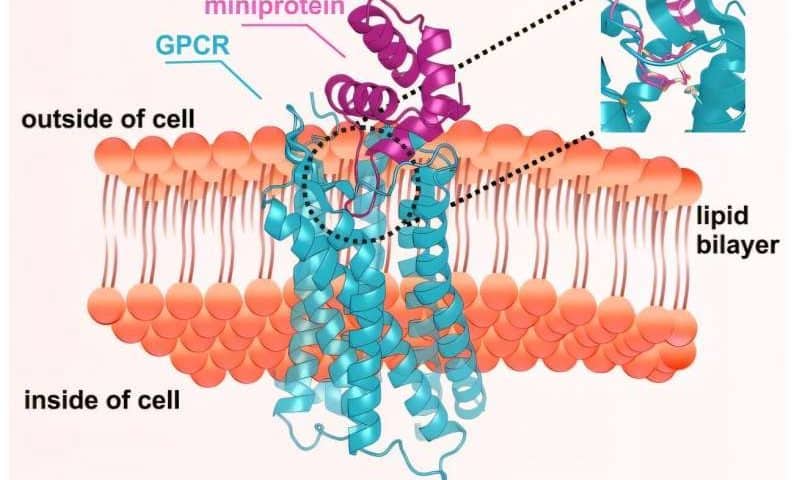
G protein-coupled receptors, or GPCRs, sit in the plasma membrane, the boundary that defines the inside and outside of a living cell. They communicate with nearly every physiological process in our bodies—from the ability to see and smell, to sensing of adrenaline, insulin, nutrients and medicines.
A key challenge has been developing molecules that can toggle GPCRs on and off in different contexts. Doing so would not only provide insight into how these receptors control almost every bodily function, but also inroads to medicines for a host of diseases that lack treatments.
The UW Medicine Institute for Protein Design and Skape Bio led a new study showing for the first time that AI can be used to create computationally designed proteins to activate or block GPCRs.
Their findings are published in Nature.
“Protein design takes our understanding of how proteins fold and reverses it—asking if we can envision, with the aid of AI computing, a new protein that sticks to a target in a purpose-built way,” said senior author David Baker, director of the UW Medicine Institute for Protein Design.
“This paper showcases how we can do this repeatedly for different GPCRs in ways that capitalize on their dynamic motion to either activate or inactivate them. The result is a generalized approach to targeting biologically critical receptors,” added Baker, who is a professor of biochemistry at the University of Washington School of Medicine and a Howard Hughes Medical Institute Investigator.
The signaling switch of GPCRs sits in deep flexible pockets, the shape of which makes them difficult to target. The team developed specialized design strategies to build miniproteins (proteins with fewer than 100 amino acids) that can slip into these hard-to-access sites. This approach enabled the generation of molecules designed to either activate or block signaling.
By targeting specific active or inactive receptor states, the team designed miniproteins that precisely control GPCR signaling in cells, either turning it on or shutting it down. Structural studies showed that several closely matched their design models. In one mouse study, a designed miniprotein performed comparably to a clinically used drug while showing fewer side effects.
“Existing drugs such as antibodies bind to but often fail to activate or block GPCR signaling,” said Edin Muratspahić, an Institute for Protein Design postdoctoral research scholar and a first author of the study. “Seeing computationally designed miniproteins not only bind but actually control GPCR signaling in living cells was a defining moment for me.”
To accelerate the discovery of designed proteins targeting GPCRs, the researchers also invented a new screening system. Traditional screening is difficult for these receptors because many methods require that they be purified, stabilized, or otherwise altered in ways that can change their signaling.
By working directly in living human cells, the new system can test tens of thousands of proteins against GPCRs while keeping the receptors in the cell membrane.
“The methods we are sharing in this new study form the roadmap for achieving all-computational design of protein ligands for any GPCR,” said Christoffer Norn, corresponding author and co-founder of Skape Bio.
“One of the great strengths of the Institute for Protein Design is its capacity to drive its research quickly from the university setting to start-ups that can carry that work forward into real-world impact.”
“At Skape Bio,” added Norn, “we are achieving this impact by maturing the methods and approaches necessary to deliver therapies for patients across a wide range of diseases where GPCRs are known to be effective targets, but where medicines have not previously been available.”