Fighting antibiotic resistance: Surface coating that kills germs can be reactivated using light

Antibiotic-resistant bacteria and emerging viruses are a rapidly increasing threat to the global health care system. About 5 million deaths each year are linked to antibiotic-resistant germs, and more than 20 million people died during the COVID-19 virus pandemic. Empa researchers are therefore working on new, urgently needed strategies to combat such pathogens. One of the goals is to prevent the spread of resistant pathogens and novel viruses with smart materials and technologies.

Surfaces that come into constant contact with infectious agents, such as door handles in hospitals or equipment and infrastructure in operating theaters, are a particularly suitable area of application for such materials.

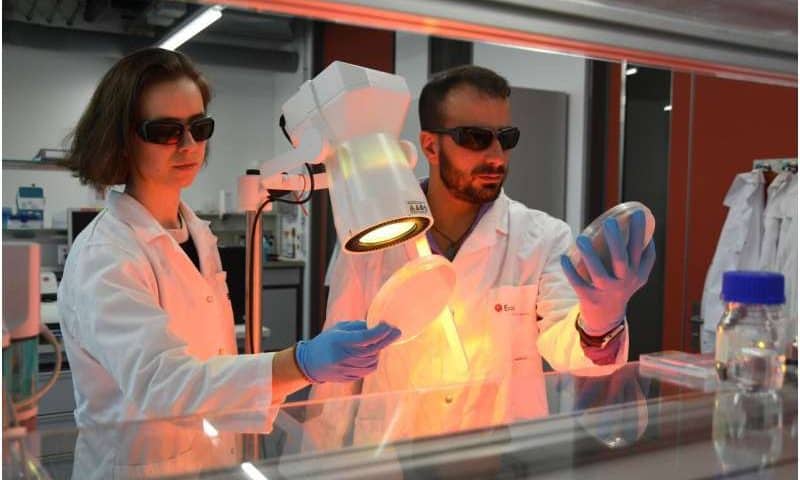
An interdisciplinary team from three Empa laboratories, together with the Czech Palacký University in Olomouc, has now developed an environmentally friendly and biocompatible metal-free surface coating that reliably kills germs. The effect can be reactivated again and again by exposing it to light. The study is published in the journal EcoMat.

Biocompatible and effective

“The new material is designed to kill microorganisms locally and quickly,” explains Giacomo Reina from Empa’s Nanomaterials in Health Laboratory in St. Gallen. A basic matrix of polyvinyl alcohol, a biocompatible plastic that is also used in the food industry, was used for this purpose. Embedded in this matrix is specially synthesized graphenic acid, which is ideally suited as an antimicrobial coating due to its chemical properties.

Its full potential can be exploited by using near-infrared light. As soon as the composite material is irradiated, it unfolds its dual strategy: First, it absorbs the energy of the infrared light and converts it into germicidal heat. It also stimulates the formation of oxygen radicals, which cause additional damage to the pathogens.

Another advantage here is that this strategy is completely different from the mode of action of conventional antibiotics. The material thus offers continuous protection against a broad spectrum of microorganisms without contributing to the development of resistance. “Our laboratory experiments have clearly confirmed the effectiveness of the antimicrobial material against various bacteria and viruses,” says Reina.

Application for dentistry

An initial application for the antimicrobial coating is currently being developed for dentistry. To this end, Empa researchers are working together with the Center for Dental Medicine at the University of Zurich on a dental splint that kills microorganisms in the oral cavity.

The microbial flora in the mouth is a particularly unpleasant opponent in the fight against infectious agents: Complex communities of bacteria cavort in inaccessible niches, embedded in a self-produced mucous matrix. Antibiotics and disinfectants barely penetrate these resistant biofilms. This allows the germs to ruin teeth unhindered or even lead to extensive infections in the body.

The interdisciplinary team led by Reina is therefore working on a plastic splint into which nanomaterials such as graphenic acid can be stably integrated. As near-infrared light can penetrate the tissue several centimeters deep, the splint can be placed in the oral cavity and activated from the outside by a light source, over and over again.

Bioprocess 5.0: Straddles the Human-AI Divide to Scale Next-Gen Therapies

In recent decades, sensor-less cars that rely on human decision-making have evolved into self-driving taxis that arrive on demand. Beate Mueller-Tiemann, PhD, CTO of the global life sciences company Cytiva, points to these autonomous vehicles as an analogy for the digitization of the biomanufacturing industry, which has recently culminated in a new era known as “Bioprocess 5.0.” This latest generation integrates advanced digital technologies, automation, and sustainability principles to streamline the production of biological products, such as pharmaceuticals, vaccines, and enzymes.

“Pharma companies like to use the term ‘smart manufacturing,’ in which operations are driven not only by serendipity and diligent work, but by data-driven insights and adaptive process control,” explained Mueller-Tiemann in an interview with GEN.

5.0 pillars

The hallmarks of Bioprocess 5.0 include the incorporation of artificial intelligence (AI) tools to optimize and control of bioprocess parameters in real-time to support improved quality and standardization. For example, virtual replicas that simulate processes, known as “digital twins,” can test scenarios while minimizing risk to actual production runs, thereby increasing process consistency, limiting error, and increasing speed-to-clinic.

“Successful bioprocessing pipelines will maintain a focused approach, in which upstream and downstream efforts are connected with a focus on yield, robustness, and reproducibility,” Sebastián Arana, head of process solutions life science business of Merck KGaA, Darmstadt, Germany. told GEN. He emphasizes that data should be leveraged at every stage for faster decisions and fewer batch failures.

Arana also notes that sustainability goals remain at the forefront of Bioprocess 5.0, with the use of renewable energy being one of the most impactful movements to decrease the footprint of bioprocessing production. MilliporeSigma is the U.S. and Canada Life Science business of Merck KGaA, Darmstadt, Germany. It currently operates with 78% renewable electricity and is aiming to increase that value to over 90% in Q1 of 2026.

“The next chapter is the transition to focusing on reducing the footprints of the individual products and increasing the intensification of bioprocessing,” explained Arana. Aligned with this goal, MilliporeSigma is driving a Design for Sustainability program into the company’s R&D pipelines. The program develops eco-friendly and disposable products.

Sigma Mostafa, PhD, CSO at KBI Biopharma, highlights the incorporation of human-centric automation within Bioprocess 5.0, in which digital tools are designed to work with humans to enhance manufacturing capabilities. She says the emphasis remains on scientists working with software as opposed to machines replacing humans.

“You can come up with the best automation or machine-learning solution, but it may not take into account new sustainability solutions or how the industry and market are changing. 5.0 brings that holistic perspective,” Mostafa said. She lists particle characterization as an example process that bridges the balance between human decision-making and digital tools.

While machine-learning models can improve the precision of comprehensive analyses of the physical and chemical properties in a drug formulation, effectively evaluating the safety, efficacy, stability, and manufacturability of a drug requires living scientists to leverage existing knowledge from the literature to assist interpreting model results.

Scaling personal therapies

Mueller-Tiemann looks to CAR T manufacturing for autologous cancer cell therapy as a prime example of the need for autonomous systems. Specifically, as many CAR T therapeutics are moving toward autoimmune diseases with larger patient populations, manufacturers and technology providers will need to develop solutions that scale to that expanded reach.

Aligned with this goal, Cytiva announced a partnership in January that combines the company’s manufacturing technologies with the robotic platform of Cellular Origins, a cell therapy-focused manufacturing company, to enable production of cell and gene therapies for larger populations.

The recent story of Baby KJ, an infant who became the first patient to receive a bespoke gene editing therapy to treat his severe metabolic disorder, has also added new hope for scaling personalized therapies.

KJ was diagnosed with severe carbamoyl phosphate synthetase 1 (CPS1) deficiency, an often fatal urea cycle disorder with an estimated 50% mortality in early infancy. Given these urgent timelines, the FDA granted accelerated approval for his experimental bespoke base-editing therapy manufactured by Danaher-owned companies, Aldevron and Integrated DNA Technologies.

According to Kiran Musunuru, MD, PhD, one of the lead physicians overseeing KJ’s case and professor of translational research at Perelman School of Medicine at the University of Pennsylvania, the therapy’s cost was “not as expensive as you might think.” While the traditional approval route for gene editing therapies requires years of rigorous studies to demonstrate safety and effectiveness, the fast timelines to address KJ’s urgent health status significantly lowered costs compared to standard drug development. However, the bioprocessing industry is still wrestling with establishing a reproducible scalability blueprint that would support similar cases beyond KJ’s treatment.

When reflecting on the broader impact of single patient cases, Peter Marks, MD, PhD, former director of the Center for Biologics Evaluation and Research (CBER) at the FDA, urged regulatory approaches to leverage the information that is used repeatedly from product to product, while allowing for the required customization, such as guide RNA in the case of CRISPR constructs.

“Facilitating such a process could transform N-of-1 therapy into N-of-many therapies, thus leading to commercial viability of these products for rare diseases—a development that would ultimately benefit many persons with great unmet medical need,” Marks wrote earlier this year in an editorial in The New England Journal of Medicine.1

Complex molecules

The complexity of biomolecules has greatly evolved from the advent of monoclonal antibodies nearly half a century ago. Modalities such as antibody drug conjugate (ADC)-based drugs, a class of cancer therapies that combine the targeting ability of antibodies with the cell-killing power of cytotoxic drugs, require additional regulatory and manufacturing considerations, which can slow uptake. Despite adoption challenges, Mueller-Tiemann emphasizes that evolving therapies will mature and are here to stay.

“Complex new biologics, like ADCs, now mean we have a need for our scientists who have both a biologics and chemistry understanding because you have to be able to conjugate, purify, and analyze these materials to get the right product,” explained Mueller-Tiemann.

Aligned with this trajectory, Enhertu, an ADC-based blockbuster drug that first received FDA approval in December 2019 for the treatment of adult patients with unresectable or metastatic HER2-positive breast cancer, achieved global sales exceeding $1.6 billion in 2022.

Back at Millipore Sigma, the manufacturing of ADCs has advanced thanks to an alliance for Antibody Drug Conjugate Drug Substance and Drug Product Manufacturing Services with Simtra Biopharma Solutions. Announced in June, the partnership creates a turnkey offering for biopharmaceutical companies seeking ADC and bioconjugation, linker/payload manufacturing, drug product formulation development, and fill-finish capabilities.

“Connecting the bioconjugation and fill-finish steps will be a value-add for our clients, meeting their ambitious timelines and allowing the broadest number of patients to benefit in the fastest and safest possible way,” Benjamin Hein, head of life science services, life science business of Merck KGaA, Darmstadt, Germany, told GEN.

Taken together, Mostafa emphasizes that Bioprocess 5.0 is not being applied to “local optima” that focus on a specific facility or equipment, but is aimed at broader solutions.

“Have we improved our sustainability metrics and overall human experience? Is there a clear definition of the value proposition for humans? When we can articulate these points and people’s roles evolve, that’s where 5.0 truly will kick in,” says Mostafa.

Lilly Chooses Virginia Site for $5B API Manufacturing Facility, with ADCs in Mind

Eli Lilly said it has chosen a location near Richmond, VA, for its planned $5 billion manufacturing plant that will be the first-ever dedicated, fully integrated active pharmaceutical ingredient (API) and drug product facility for the pharma giant’s bioconjugate platform and monoclonal antibody portfolio.

Lilly has chosen the West Creek Business Park in Virginia’s Goochland County for the facility, which will manufacture APIs for therapies designed to treat cancer, autoimmune diseases, and other disorders—including antibody-drug conjugates (ADCs).

The planned Goochland County facility is the first that Lilly has revealed since announcing in February that it would roughly double—to more than $50 billion since 2020—its planned spending on U.S.-based manufacturing by building four new facilities. At the time, Lilly said three of the facilities would be API manufacturing sites, while the fourth would extend the company’s global parenteral manufacturing network for future injectable therapies.

The locations of the other three sites will be announced later this year, Lilly said.

“Our investment in Virginia underscores our commitment to U.S. innovation and manufacturing—creating high-quality jobs, strengthening communities, and advancing the health and well-being of Americans nationwide,” David A. Ricks, Lilly’s chair and CEO, said in a statement. “By expanding our domestic capacity, we’re building a secure, resilient supply chain that delivers for patients today and supports the breakthrough medicines of tomorrow.”

Ricks is among biopharma CEOs whose companies have announced plans for a combined $290 billion-plus in new and renovated facilities. While primarily focused on manufacturing, some of the companies have unveiled projects intended to bolster R&D and other operations.

The announcements have trickled out in recent months as President Donald Trump’s administration has pressed the biopharma industry to make more of its products in the United States, in part by threatening to impose tariffs on pharma imports. Ricks is a Trump ally who publicly credited the president’s earlier 2017 tax cuts with enticing them to build their manufacturing sites in the United States.

“We will continue to bring more capacity online in 2025 and expect our production capabilities to increase further,” Ricks told analysts on August 7 on the company’s quarterly earnings call following the release of second-quarter results. On the call, he said Lilly planned two manufacturing site announcements during the current third quarter—the Virginia site and a site yet to be announced.

Choosing Virginia

Lilly is the second pharma giant to announce plans for a multi-billion-dollar manufacturing plant in Virginia in recent months. The first was AstraZeneca, which in July joined Gov. Glenn Youngkin (R) in revealing plans for what the company said will be its largest-ever manufacturing facility at a site in the Old Dominion State—later revealed to be within Albemarle County, near Charlottesville, VA.

Virginia is part of the BioHealth Capital Region, along with Maryland and Washington, D.C. The region ranks number three in GEN’s most recent A-List of Top 10 U.S. Biopharma Clusters.

Lilly said it chose Goochland County from “several hundred” applications seeking the API facility based on criteria that included, but were not limited to, the potential of the workforce in Greater Richmond, ready access to utilities and transportation, favorable zoning, and economic incentives.

Youngkin announced that the state’s public-private economic development agency, the Virginia Economic Development Partnership, worked with Goochland County and the General Assembly’s Major Employment and Investment (MEI) Project Approval Commission to secure the project for Virginia.

Lilly will be eligible for an MEI Commission-approved special appropriation of up to $130 million, subject to approval by the Virginia General Assembly. The $130 million package was based on the pharma giant’s original plans for the site, which called for investing more than $2.148 billion and creating 468 jobs.

Lilly now expects the project to generate 1,800 construction jobs, followed by more than 650 new high-paying jobs that will include positions for engineers, scientists, operations personnel, and lab technicians. The company employs more than 49,000 people worldwide, of which roughly half (22,000 employees) are based in the United States. Lilly has manufacturing facilities in nine countries, including the United States, where it has sites in its headquarters state of Indiana, North Carolina, as well as New Jersey, Wisconsin, and Puerto Rico.

Lilly plans to build the Goochland County API site within five years.

“This isn’t just another manufacturing site—it represents a significant milestone for Lilly, as we begin building our first bioconjugate facility,” said Edgardo Hernandez, executive vice president and president of Lilly Manufacturing Operations. “With this cutting-edge site, Lilly is setting a new benchmark in bioconjugate innovation, advancing technologies that will expand what’s possible for patients.

Aspirin halves the risk of recurrence in patients with colorectal cancer, clinical trial finds

A Swedish-led research team at Karolinska Institutet and Karolinska University Hospital has shown in a new randomized clinical trial that a low dose of the well-known medicine aspirin halves the risk of recurrence after surgery in patients with colon and rectal cancer with a certain type of genetic alteration in the tumor.

Every year, nearly two million people worldwide are diagnosed with colorectal cancer. Between 20 and 40% develop metastases, which makes the disease both more difficult to treat and more deadly.

Previous observational studies have suggested that aspirin may reduce the risk of certain cancers and possibly also the risk of recurrence after surgery in patients with colorectal cancer harboring mutations in genes within the PIK3 signaling pathway.

These genes regulate key cellular processes such as growth and division. When mutated, these processes can become dysregulated, leading to uncontrolled cell proliferation and cancer development. However, prior findings have been inconsistent and no randomized clinical trials had previously confirmed the association. To address this gap, the ALASCCA trial was initiated and has now been published in The New England Journal of Medicine.

The current study included more than 3,500 patients with colon and rectal cancer from 33 hospitals in Sweden, Norway, Denmark, and Finland. Patients whose tumors showed a specific genetic mutation in the PIK3 signaling pathway—a mutation found in approximately 40% of patients—were randomized to receive either 160 mg of aspirin daily or a placebo for three years after surgery.

For patients with the genetic mutation in PIK3, the risk of recurrence was reduced by 55% in those who received aspirin compared with the placebo group.

“Aspirin is being tested here in a completely new context as a precision medicine treatment. This is a clear example of how we can use genetic information to personalize treatment and at the same time save both resources and suffering,” says first author Anna Martling, professor at the Department of Molecular Medicine and Surgery, Karolinska Institutet, and senior consultant surgeon at Karolinska University Hospital.

So how does aspirin reduce the risk of recurrence of colon and rectal cancer? The researchers believe that the effect is likely due to aspirin acting through several parallel mechanisms—it reduces inflammation, inhibits platelet function and tumor growth. This combination makes the environment less favorable for cancer.

“Although we do not yet fully understand all the molecular links, the findings strongly support the biological rationale and suggest that the treatment may be particularly effective in genetically defined subgroups of patients,” says Martling.

The researchers believe that the results could have global significance and influence treatment guidelines for colon and rectal cancer worldwide. Martling sees the fact that the drug is well established as a major advantage.

“Aspirin is a drug that is readily available globally and extremely inexpensive compared to many modern cancer drugs, which is very positive,” says Martling.

Antipsychotic-treated patients with schizophrenia see benefits from semaglutide, study claims

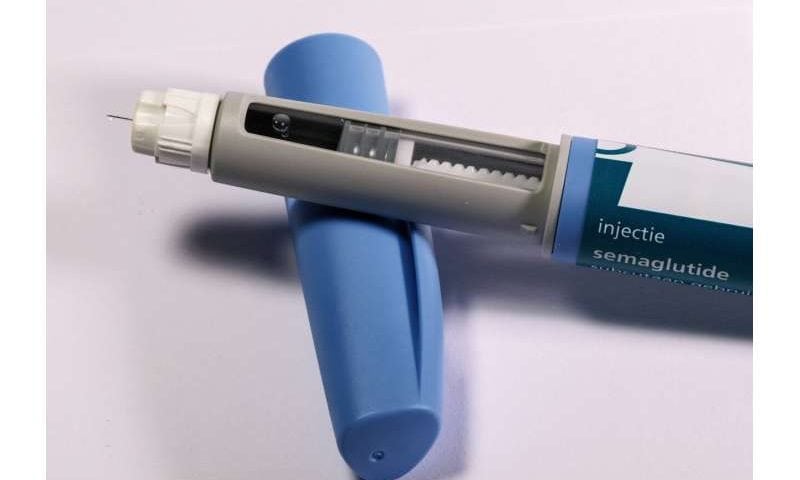
A multicenter collaboration of Danish researchers reports that once-weekly semaglutide for 30 weeks lowered blood sugar levels and body weight and improved physical quality of life in antipsychotic-treated adults with schizophrenia and prediabetes.

Cardiometabolic illness cuts life expectancy in schizophrenia, with lifestyle risks and barriers to physical care adding to the burden. Second-generation antipsychotics can accelerate weight gain and impair glucose tolerance.

Previous trials of GLP-1 receptor agonists in psychiatric populations tested shorter courses or different agents and left a need for options that address glycemia and weight while preserving psychiatric stability.

In the study, “Semaglutide Treatment of Antipsychotic-Treated Patients With Schizophrenia, Prediabetes, and Obesity: The HISTORI Randomized Clinical Trial,” published in JAMA Psychiatry, researchers conducted a placebo-controlled, double-blinded randomized clinical trial to test whether semaglutide improves glycemic control, weight, and quality of life in this population.

Enrollment included 154 adults aged 18–60 years receiving second-generation antipsychotics across two Danish regions, with 141 completing 30 weeks. A randomization schedule was provided by the drug manufacturer, Novo Nordisk, along with semaglutide and a placebo.

Intervention used once-weekly subcutaneous semaglutide or placebo for 30 weeks with an eight-week titration to 1.0 mg or highest tolerated dose.

Visits and assessments took place primarily in participants’ homes. The primary outcome was change in blood sugar levels (HbA1c). Secondary outcomes included body weight, fasting glucose, lipid measures, and schizophrenia symptoms based on Positive and Negative Syndrome Scale–6 (PANSS-6), and SF-36v2 physical and mental component scores.

Results showed an HbA1c reduction of 0.46% of total hemoglobin versus placebo at week 30, with a significant effect visible at week 15 and was maintained through the final on-treatment assessment at week 30.

Body weight fell by 9.21 kg versus placebo at week 30. An HbA1c below 5.7% occurred in 81% on semaglutide versus 19% on placebo. HDL rose by 10.81 mg/dL and triglycerides decreased by 29.20 mg/dL.

An inconsistent significance in the triglyceride decrease introduces a red flag that needs to be explained by the study authors.

The study reports the data as a decrease of -29.20 mg/dL (95% CI, -55.75 to 2.65; P = .03), which cannot be correct as a CI that crosses 0 should not have a P value below .05. It is likely a sign error (-2.65 vs. the printed +2.65), though it appears in multiple locations in the study along with several reversals of CI upper and lower bound orders.

Physical quality of life improved by 3.75 points. Mental quality of life and PANSS-6 scores showed no significant between-group differences. Gastrointestinal symptoms appeared more often with semaglutide early in treatment and improved over time. Serious adverse effects did not differ between groups.

Authors conclude that semaglutide at 1.0 mg weekly for 30 weeks was safe in this cohort, improved glycemia and weight, and enhanced physical well-being without psychiatric deterioration.

Findings suggest a candidate therapy for SGA-treated patients with schizophrenia, prediabetes, and obesity, with authors noting that the potential for weight loss and prevention of type 2 diabetes may justify treatment cost.

Ubiquitin’s ability to tag synthetic compounds offers new path to drug discovery

Small but powerful: Ubiquitin controls the lifespan and distribution of proteins in the cell, but it can also determine their shape, function, or interactions with other cellular components. Ubiquitin ligases are key to this process because they reliably recognize the relevant proteins among tens of thousands of molecules and confer the correct instructions. Disruptions of this precise tagging routine can result in faulty cellular processes and diseases such as cancer.

Conversely, drugs can be designed to modulate ubiquitin ligases, directing them to tag specific disease-promoting proteins with ubiquitin for degradation. However, this principle is currently only applicable to a few of the more than 600 human ubiquitin ligases.

The ubiquitin ligase HUWE1 is an interesting, yet unexploited target for therapeutic strategies with important roles in tumors and neurodevelopmental disorders. Although drug-like compounds have been used to inhibit HUWE1 in scientific research, their mechanism of action remained unclear, hindering their advancement into potential therapeutic agents.

Challenging discovery process

A team led by Sonja Lorenz at the MPI for Multidisciplinary Sciences has now unraveled the unexpected mechanism by which these compounds act. Using an interdisciplinary approach, the researchers combined protein biochemistry, cell biology, and click chemistry.

Other key methods for the project’s success were tailor-made molecular syntheses from medicinal chemists led by Matthias Gehringer at the University of Tübingen, as well as the mass spectrometric measurements by Henning Urlaub’s research group and molecular dynamics simulations by colleagues from Helmut Grubmüller’s department at the MPI, Lorenz emphasizes.

Competition instead of inhibition

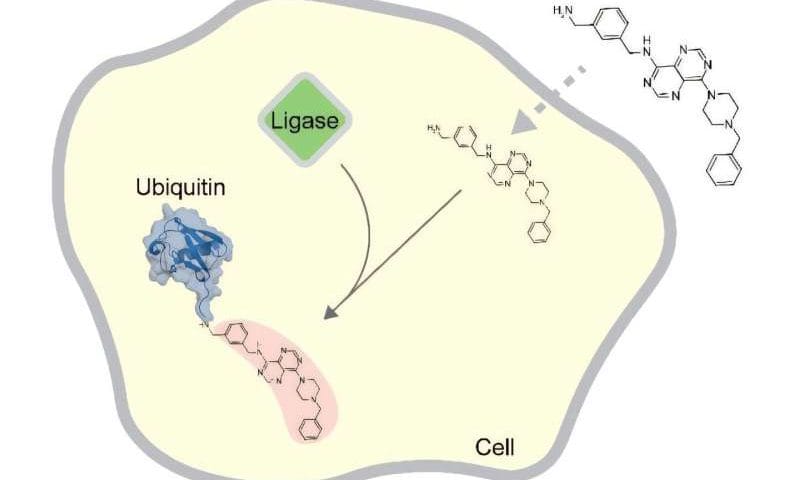
“We found that the drug-like compounds marketed as HUWE1 inhibitors indeed interact with this enzyme—but they do not inhibit it. Rather, HUWE1 recognizes the compounds themselves as target molecules and tags them with ubiquitin,” reports Lorenz.

“When the drug-like compounds are supplied in excess over a natural target protein in the test tube, they consume the ubiquitin. This competition between the drug-like compounds and the target protein is what had previously been misinterpreted as HUWE1 inhibition,” adds Pavel Pohl, one of the lead authors of the study now published in the journal Nature Communications.

The team also succeeded in demonstrating, for the first time, that the synthetic compounds are tagged with ubiquitin in living cells. However, the situation here is much more complex than in the test tube.

“In the cell, HUWE1 promotes the ubiquitination of the compounds, but it does not drive it exclusively,” explains Barbara Orth, another lead author of the study. This implies that cellular ubiquitination enzymes other than HUWE1 can also tag drug-like molecules with ubiquitin. This finding is of fundamental importance because ubiquitin signals had previously only been observed on proteins, sugars, and other biomolecules in cells, but not on synthetic compounds.

“The novel substrate spectrum will be particularly interesting for therapeutic and biotechnological applications in the ubiquitin field. Our discovery offers tangible strategies for developing new molecular tools to modulate the cellular ubiquitin system and, in turn, influence disease processes,” explains Lorenz.

New Cas9 proteins dramatically lower the error rate of prime editing

A genome-editing technique known as prime editing holds potential for treating many diseases by transforming faulty genes into functional ones. However, the process carries a small chance of inserting errors that could be harmful.

MIT researchers have now found a way to dramatically lower the error rate of prime editing, using modified versions of the proteins involved in the process. This advance could make it easier to develop gene therapy treatments for a variety of diseases, the researchers say.

The work is published in the journal Nature.

“This paper outlines a new approach to doing gene editing that doesn’t complicate the delivery system and doesn’t add additional steps, but results in a much more precise edit with fewer unwanted mutations,” says Phillip Sharp, an MIT Institute Professor Emeritus, a member of MIT’s Koch Institute for Integrative Cancer Research, and one of the senior authors of the new study.

With their new strategy, the MIT team was able to improve the error rate of prime editors from about one error in seven edits to one in 101 for the most-used editing mode, or from one error in 122 edits to one in 543 for a high-precision mode.

“For any drug, what you want is something that is effective, but with as few side effects as possible,” says Robert Langer, the David H. Koch Institute Professor at MIT, a member of the Koch Institute, and one of the senior authors of the new study. “For any disease where you might do genome editing, I would think this would ultimately be a safer, better way of doing it.”

Koch Institute research scientist Vikash Chauhan is the lead author of the paper.

The potential for error

The earliest forms of gene therapy, first tested in the 1990s, involved delivering new genes carried by viruses. Subsequently, gene-editing techniques that use enzymes such as zinc finger nucleases to correct genes were developed. These nucleases are difficult to engineer, however, so adapting them to target different DNA sequences is a very laborious process.

Many years later, the CRISPR genome-editing system was discovered in bacteria, offering scientists a potentially much easier way to edit the genome. The CRISPR system consists of an enzyme called Cas9 that can cut double-stranded DNA at a particular spot, along with a guide RNA that tells Cas9 where to cut. Researchers have adapted this approach to cut out faulty gene sequences or to insert new ones, following an RNA template.

In 2019, researchers at the Broad Institute of MIT and Harvard reported the development of prime editing: a new system, based on CRISPR, that is more precise and has fewer off-target effects. A recent study reported that prime editors were successfully used to treat a patient with chronic granulomatous disease (CGD), a rare genetic disease that affects white blood cells.

“In principle, this technology could eventually be used to address many hundreds of genetic diseases by correcting small mutations directly in cells and tissues,” Chauhan says.

One of the advantages of prime editing is that it doesn’t require making a double-stranded cut in the target DNA. Instead, it uses a modified version of Cas9 that cuts just one of the complementary strands, opening up a flap where a new sequence can be inserted. A guide RNA delivered along with the prime editor serves as the template for the new sequence.

Once the new sequence has been copied, however, it must compete with the old DNA strand to be incorporated into the genome. If the old strand outcompetes the new one, the extra flap of new DNA hanging off may accidentally get incorporated somewhere else, giving rise to errors.

Many of these errors might be relatively harmless, but it’s possible that some could eventually lead to tumor development or other complications. With the most recent version of prime editors, this error rate ranges from one per seven edits to one per 121 edits for different editing modes.

“The technologies we have now are really a lot better than earlier gene therapy tools, but there’s always a chance for these unintended consequences,” Chauhan says.

CRISPR Mouth-Swab Test Could Transform Tuberculosis Screening

More than 10 million people develop tuberculosis (TB) each year, yet about 40% go undiagnosed. The main culprit is reliance on sputum-based testing, which many patients—particularly those who are asymptomatic—cannot provide, and which is difficult to collect in low-resource settings. A new CRISPR-based test from Tulane University aims to close that gap by detecting Mycobacterium tuberculosis (Mtb) DNA from a simple tongue swab.

The assay, called ActCRISPR-TB, integrates isothermal amplification and CRISPR-Cas12a detection in a single “one-pot” reaction. In under an hour, it can flag infection with a paper strip readout similar to a home COVID-19 test. In a Nature Communications study titled, “Sensitive pathogen DNA detection by a multi-guide RNA Cas12a assay favoring trans- versus cis-cleavage,” the test identified TB in 74% of tongue swab samples—outperforming traditional testing methods, which reached only 56% sensitivity on the same specimens. Sensitivity was even higher for respiratory samples (93%), pediatric stool (83%), and adult spinal fluid (93%), underscoring its potential to diagnose TB in patients who cannot provide sputum.

“For TB diagnostics, we need point-of-care technology because TB is a disease related to poverty,” lead author Zhen Huang, PhD, assistant professor at Tulane University School of Medicine, told GEN. He added that most TB cases occur in remote areas with limited resources. “…we have to use the point-of-care to increase the accessibility for TB diagnostics.”

Filling the sputum gap

Traditional TB tests depend on mucus collected from the lungs, but sputum testing is impossible in roughly 25% of symptomatic patients and nearly 90% of asymptomatic ones. That leaves millions undetected and untreated, allowing the disease to spread. By focusing on easily collected oral samples, ActCRISPR-TB could enable large-scale screening campaigns in communities where trained medical staff and laboratory infrastructure are scarce.

The technology builds on the team’s earlier two-step CRISPR assay, which detected Mycobacterium tuberculosis cell-free DNA in blood with high sensitivity and specificity, even identifying extrapulmonary and pediatric cases missed by sputum-based diagnostics—but streamlines the process into a single tube, reducing contamination risk and equipment needs. The team validated the new method in more than 600 clinical specimens across multiple sample types, including “adult respiratory, pediatric stool, and adult cerebral spinal fluid specimens,” the authors wrote.

ActCRISPR-TB uses guide RNAs that favor trans-cleavage activity, and the authors wrote “that sensitivity could be further enhanced by the use of Cas12a RNPs targeting distinct sites on their target amplicon.” A tongue swab is added to a tube preloaded with reagents and a lateral-flow test strip. After 45 minutes of incubation at about body temperature, colored bands reveal a positive or negative result—no specialized instrumentation required.

The team has currently resolved the two key challenges of complexity and contamination, Huang explained. “In the paper, we compared our assay with other CRISPR assays for TB diagnostics.”

Broader potential

Huang and colleagues envision expanding the platform beyond tuberculosis.

“I think there is a potential to integrate AI into our system,” Huang said. “If we can use AI to help us screen, we can find more efficient…systems for other pathogens.” It means that we can quickly expand the assay from TB to other pathogens, especially for emergency diseases such as COVID-19…[or] monkeypox.”

Looking ahead

While the proof-of-concept results are promising, larger community-based studies will be needed to confirm performance in real-world screening—particularly among asymptomatic individuals with very low bacterial loads. The authors caution that tongue swabs still face hurdles. In their trial, 26% of tuberculosis cases that were positive by sputum testing produced negative tongue-swab results. They noted that M. tuberculosis DNA levels are typically lower on the tongue and can fluctuate with sampling technique, disease burden, infection site, and even everyday activities that affect “respiratory material transfer to and depletion from the oral cavity.” Such variability, they added, “can complicate the translation of swab-based diagnostics into clinical practice,” though lessons from COVID-19 testing—such as repeat testing or using more homogeneous saliva samples—may help address these challenges.

By eliminating the need for sputum and expensive equipment, ActCRISPR-TB could offer a path to earlier detection and treatment—critical steps toward the global goal of ending TB.

Novartis Inks Up-to-$5.7B Second Collaboration with Monte Rosa

Nearly a year after licensing Monte Rosa Therapeutics’ Phase II-bound autoimmune disease candidate MRT-6160, Novartis has agreed to partner on developing additional molecular glue degraders (MGDs) for immune-mediated diseases, in an expanded collaboration that could generate more than $5.7 billion for the Boston biotech.

Novartis plans to develop an unspecified number of degraders based on Monte Rosa’s artificial intelligence (AI) and machine learning (ML)-based Quantitative and Engineered Elimination of Neosubstrates (QuEEN™) discovery engine. QuEEN is designed to identify degradable protein targets and rationally design MGDs with what the company calls unprecedented selectivity, through the platform’s combination of AI-guided chemistry, diverse chemical libraries, structural biology, and proteomics.

In the second collaboration the companies have announced in 11 months, Novartis agreed to work with Monte Rosa on developing degraders for immune-mediated diseases targeting “highly credentialed” and difficult-to-drug targets.

Novartis also acquired an exclusive, royalty-bearing, sublicensable, and transferable license to an undisclosed discovery target and agreed to acquire options to license two programs from Monte Rosa’s preclinical immunology portfolio.

“This new agreement underscores our commitment to advancing targeted protein degradation as a promising approach to address immune-mediated diseases with high unmet need,” Fiona H. Marshall, PhD, Novartis’ president of biomedical research, said in a statement. “We believe Monte Rosa’s QuEEN™ platform has the potential to uncover new insights in this field. We look forward to working together to translate these insights into transformative therapies for patients.”

The latest Monte Rosa collaboration is Novartis’ fourth commitment of more than $1 billion announced this month alone. The pharma giant started September by inking an up-to-$2.2 billion partnership with Arrowhead Pharmaceuticals to license and develop Arrowhead’s preclinical small interfering RNA (siRNA) therapy ARO-SNCA, a potential treatment for Parkinson’s disease and other synucleinopathies, plus additional targets. Also this month, Novartis agreed to acquire Tourmaline Bio for $1.4 billion, and raised its potential payout to up-to-$5.2 billion in an expanded collaboration with Shanghai Argo Biopharmaceutical focused on cardiovascular disease candidates.

44% surge

Investors appeared to share Novartis’ enthusiasm for partnering with Monte Rosa, as shares of the Boston-based biotech leaped to $7.39 soon after the start of trading Monday before settling for a 44% surge, to $6.93 from Friday’s close of $4.81. Those shares sank two percent to $6.78 as of 10:35 AM ET. Novartis’ shares on the SIX Swiss Exchange dipped 1.2% to CHF 97.66 ($122.97) Monday and slipped another 0.6% to CHF 97.05 as of 10:17 AM ET Tuesday.

“We see this collab as a strong validation of GLUE’s molecular glue platform and a substantial non-dilutive capital at $400M cap to support multiple Ph2 readouts and many catalysts in the next 12 months,” Clara Dong, PhD, equity analyst with Jefferies, and three colleagues, wrote Monday in a research note, using the stock ticker symbol for Monte Rosa.

The latest collaboration follows the global exclusive license Novartis acquired in October 2024 to apply QuEEN toward developing T and B cell-modulating MGDs targeting the VAV1 protein, starting with Monte Rosa’s autoimmune disease candidate MRT-6160. Back then, Novartis agreed to pay Monte Rosa $150 million upfront, plus up to $2.1 billion in payments tied to achieving development, regulatory, and sales milestones, starting with the start of Phase II studies.

In the latest collaboration, according to a regulatory filing, Novartis agreed to pay Monte Rosa up to $5.7 billion, consisting of:

  • $120 million upfront;
  • Up to $60 million to maintain the options;
  • Up to $180 million in preclinical milestone payments relating to the first licensed program plus option exercise payments;
  • Up to $5.4 billion in payments tied to achieving clinical development, regulatory, and sales milestones relating to the first licensed program and two optioned immunology and inflammation (I&I) programs, to start upon the launch of Phase I studies; and tiered royalties on global net sales in the high single to low double-digit range.

The milestone payments would consist of up to $2.2 billion in potential development and regulatory milestone payments if regulatory approval is achieved for multiple indications in multiple territories; and up to $3.2 billion in potential sales milestones, to be allocated across licensed products.

‘Strong progress’

“We are extremely excited to extend our relationship with Novartis beyond our previously announced VAV1 agreement given the strong progress made to advance MRT-6160 toward initiation of multiple Phase II studies in immune-mediated diseases,” Monte Rosa’s CEO Markus Warmuth, MD, stated Monday.

“Our AI/ML-enabled QuEEN™ product engine continues to generate new insights and opportunities, delivering an expanding pipeline of programs directed against a breadth of historically undruggable immunology targets,” Warmuth said. “This new collaboration allows us to expedite the development of certain of those programs with Novartis, leveraging their recognized development and commercialization capabilities.”

Warmuth added that the latest collaboration with Novartis also benefits Monte Rosa by strengthening its financial runway beyond multiple anticipated Phase II data readouts for MRT-6160 as well as two other clinical-stage pipeline candidates. One is MRT-8102, an oral MGD that targets NEK7 to treat inflammatory diseases driven by IL-1β and the NLRP3 inflammasome. The other is MRT-2359, an MGD designed to treat castration resistant prostate cancer by inducing the interaction between the E3 ubiquitin ligase component cereblon (CRBN) and the translation termination factor GSPT1, leading to targeted degradation of GSPT1 protein.

In a presentation to investors, Monte Rosa trumpeted a “strong balance sheet providing cash runway into 2028”—the same timeframe it gave investors in reporting second quarter earnings in August—and added in a footnote that its characterization “does not reflect anticipated cash runway extension from payments associated with Novartis collaboration announced Sep[temper] 2025.”

Monte Rosa finished the second quarter with $295.5 million in cash, cash equivalents, restricted cash, and marketable securities as of June 30—down nearly 11% from $331 million as of March 31. Monte Rosa said it plans to update investors on its updated cash position and runway when it releases third quarter 2025 earnings.

According to Dong, the latest Novartis collaboration “could bring total cash to ~$380M by our est[imate], and provides runway beyond multiple Ph2 results.”

AI algorithm turns mammograms into a ‘two-for-one’ test for women’s heart health

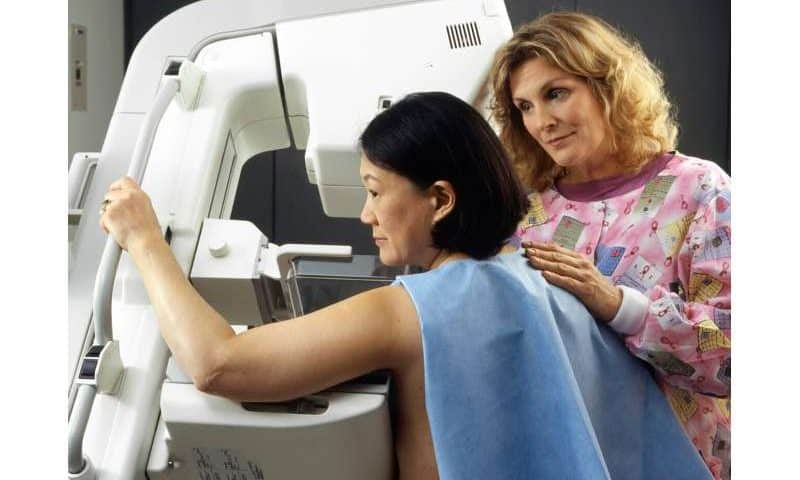
An AI algorithm based only on routine mammogram images plus age can predict a woman’s risk of major cardiovascular disease as well as standard risk assessment methods, finds research published online in the journal Heart.

And because it uses existing health infrastructure, routine mammography may offer a cost-effective ‘two for one’ effective screening option for women, suggest the researchers.

Cardiovascular disease and its risk factors are underrecognized and undertreated in women, and risk prediction algorithms have underperformed in them, point out the researchers. And while newer risk scores perform better in women than in men, they are complex and their accuracy depends on extensive medical data, which isn’t always available, they add.

The extent of arterial calcium deposits (BAC) and tissue density in the breasts have been linked to cardiovascular disease risk, but BAC isn’t associated with obesity and is negatively associated with smoking, suggesting that it’s not effective by itself, they suggest.

They therefore set out to discover if an automated AI analysis of the full range of internal breast structure and characteristics from routine mammogram images might be more accurate at cardiovascular risk prediction.

They drew on 49,196 women with an average age of 59, enrolled between 2009 and 2020 in the Lifepool cohort registry, and living in Victoria, Australia.

At enrollment, the women provided initial background health information on their age, smoking status, alcohol intake, weight (BMI), any history of diabetes and use of high blood pressure and/or high cholesterol drugs and blood thinners.

Additional information included menopause status, reproductive history and use of hormone therapy, as well as factors potentially affecting the internal structure of the breast, such as radiation, surgery, and cancer.

Some 5% of the women were current smokers, 62% had a BMI of more than 25, 6% had type 2 diabetes, 33% were taking drugs for high cholesterol, 27% for high blood pressure, and 11% were taking a blood thinner.

During an average tracking period of nearly 9 years, 3392 of these women had a first cardiovascular ‘event’: coronary artery disease (2383); heart attack (656); stroke (434) or heart failure (731).

The researchers developed an AI algorithm based on the full complement of internal breast structures and features from the mammogram images plus the woman’s age to predict major cardiovascular disease risk over 10 years.

This AI algorithm was as good as modern risk scores based on age and various clinical factors, including the New Zealand ‘PREDICT’ tool and the American Heart Association ‘PREVENT’ calculator. And it was only slightly better when various clinical factors were added.

The researchers acknowledge several limitations to their findings, including that different scanners don’t produce exactly the same data; the cardiovascular risk factors used for comparison relied on self-report; and all deep learning models are entirely dependent on their training datasets.

But they say, “A key advantage of the mammography model we developed is that it did not require additional history taking or medical record data and leveraged an existing risk screening process widely used by women.

“Mammography has potential as a ‘two-for-one’ risk assessment tool, offering efficiencies for both community and the health care system.”

They concede that “the use of mammography images to predict cardiovascular risk is novel, but the use of machine learning models to do cardiovascular risk prediction is gaining traction.”

In a linked editorial, Professor Gemma Figtree and Dr. Stuart Grieve of the University of Sydney, point out that the poor performance of traditional risk factor algorithms in women is compounded by lack of awareness of the threat posed by heart disease to women by both women themselves and the health system.

“In contrast with what is commonly thought, breast cancer causes only about 10% of the total deaths globally compared with those resulting from cardiovascular disease,” they write.

“Mammography may therefore represent a ‘touch point’ for raising awareness about cardiovascular risk and disease in women,” they suggest.

But they add, “One of the challenges with new tools that show promise for improved cardiovascular risk assessment remains implementation.”