Venezuelans cry out for change – but they dread foreign intervention
Juan Guaidó’s claim to power thrills and worries the crowds on the streets of Caracas


Juan Guaidó’s claim to power thrills and worries the crowds on the streets of Caracas
Fossil fuels provide nearly 40% of country’s power as tensions rise on phaseout timetable
An arctic blast spread painful cold across the Midwest on Friday, closing schools, opening warming centres and even intimidating ice fishermen in a taste of the even more dangerous weather expected next week.
So many people have experienced the annoyance of the little card on the doormat, saying: “Sorry we missed you.”
According to consumer group Which?, 60% of those who ordered Christmas presents online experienced problems with delivery.
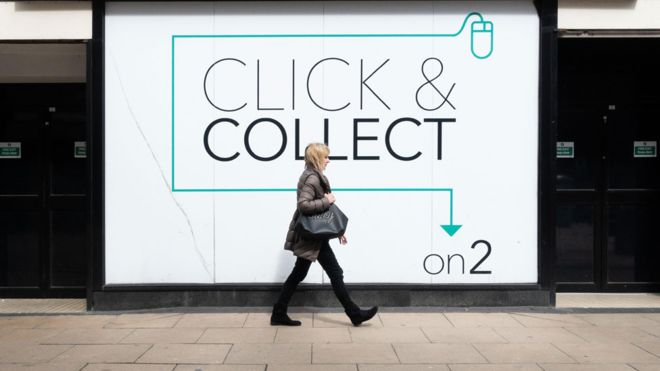
Keen to avoid parcels ending up in recycling bins or being chewed by the dog, more shoppers are choosing click-and-collect.
Could struggling retailers use the service to boost sales in-store?
Click-and-collect services are offered by retailers for online orders. Customers collect the goods at a local shop or designated pick-up point, such as a newsagent, when it’s convenient for them.
More and more retailers are now offering click-and-collect services, often free.
BBC News asked some of the UK’s biggest retailers how many online orders had been picked up in-store in 2018.
Boots said 75% of online customers had opted to pick up parcels in-store. Marks & Spencer saw 71% collected in shops.
Argos said that 60% of all sales had started online, with 80% of all sales fulfilled in Argos or Sainsbury’s stores. After the supermarket chain bought out Argos two years ago, the number of click-and-collect points increased to 1,200 – with more than 260 Argos stores inside Sainsbury’s supermarkets.
John Lewis confirmed that 50% of all online orders had been collected in-store, or in Waitrose shops also owned by the group.
Next also reported that about half of its online sales had been picked up in store via click-and-collect.
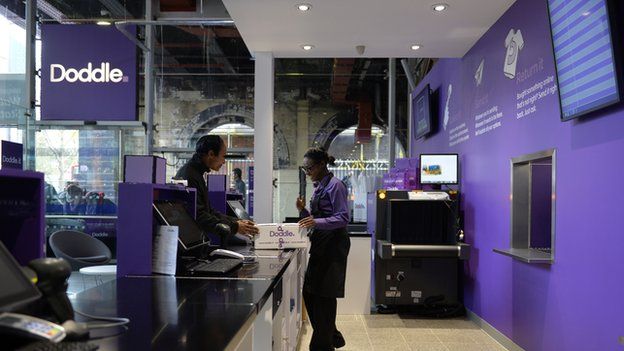
Amazon UK and Asos didn’t disclose their figures. But, their click-and-collect provider, Doddle, said customers now expected more when it came to delivery options – providing a new opportunity for retailers.
Kitty Poole, marketing and customer experience director at Doddle, said: “For years, home delivery has been the default delivery option – but that’s all changing.
“A combination of cost, convenience, trust and increasing consumer awareness about the environmental impact of delivery choices has brought about change.
“Click-and-collect has also started being competitively priced by forward thinking retailers, which is driving uptake.
“The lure of deciding when you collect and drop off parcels is a big one.”
Click-and-collect has some advantages for stores. Deliveries are less costly and complicated if they’re going to one shop, rather than multiple homes.
But, it also poses some challenges.
Logistics consultant Lynn Parnell said: “The space to store goods while they’re awaiting collection can be expensive, considering it’s taking away from the sales floor.
“Staff might also need more time to sort and organise click-and-collect only deliveries.”
She added retailers were having to develop additional technology to track deliveries, notify customers they’ve arrived, and match them to their parcel in-store.
High Street shops also face growing competition from online retailers.
Online spending in the UK reached a record 21.5% of total retail sales in November, according to the Office for National Statistics.
That dipped slightly in December, while the amount spent and the quantity bought compared with the previous month decreased by 0.9% too.
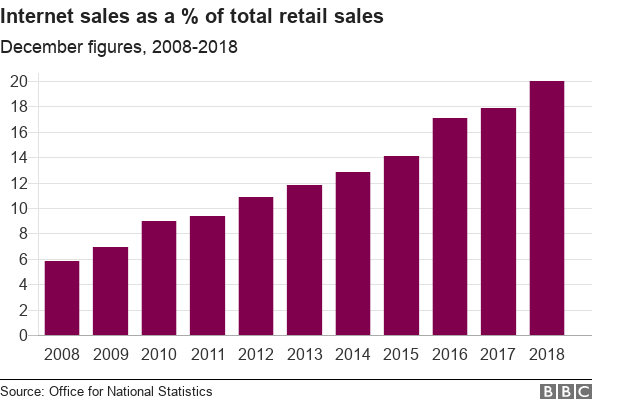
Analysts have suggested that the increasing popularity of online shopping, subdued customer demand and rising costs have combined to create a “perfect storm” for High Street stores.
With retailers having seen tough trading conditions and shop closures in 2018, it’s no surprise they might be keen to capture the extra footfall to boost physical stores.
Market research company Global Data estimates that 70% of those collecting or returning parcels make impulse in-store purchases.
In order to encourage additional spending in shops, Sports Direct offers £5 vouchers to online customers – redeemable only in shops where they’re picking up a parcel.
Other retailers, including John Lewis and Selfridges, now offer dedicated, or free, car parking spaces for those collecting goods.
The changing nature of online shopping has led some experts to question how bricks-and-mortar shops will adapt.
Retail analyst Clare Bailey said: “Click-and-collect is joining up the online and the physical.
“Retailers can save money and reduce their carbon footprint by having fewer home deliveries.
“I think the future will see shops become more of a showroom – where people try things out, go to tastings – before ordering to pick up later.”
The move marks a major shift in U.S. asylum policy.
While Japan lost ground in the global innovation race, people still view it as a leader in innovation.
Investigators said Thursday that a 2017 wildfire that killed 22 people in Northern California wine country was caused by a private electrical system, not equipment belonging to embattled Pacific Gas & Electric Corp.
India has launched what it says is the world’s lightest satellite ever to be put into orbit.
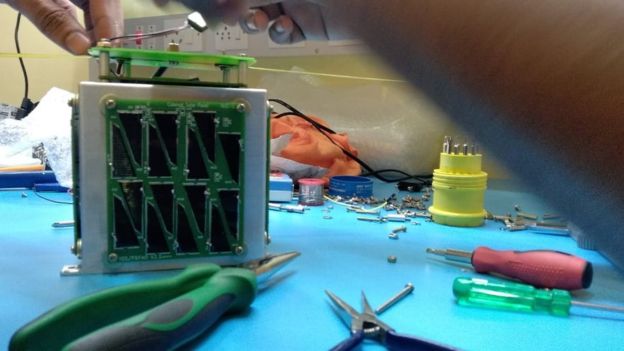
Weighing only 1.26kg (2.6lb), the Kalamsat-V2 was made by students belonging to a space education firm.
It will help ham radio operators and “inspire schoolchildren to become the scientists and engineers of the future”, India’s space agency says.
The Indian Space Research Organisation (Isro) launched the satellite from its Sriharikota space centre.
Isro chief K Sivan has claimed that “Kalamsat is the lightest satellite to be ever built and launched into orbit”.
It is also the first to be built by a private Indian firm and launched by Isro.
The celestial unit will serve as a communications satellite for ham radio transmission, a form of wireless communication used by amateurs for non-commercial activities.
An even lighter satellite, weighing 64 grams and built by the same group of students, was launched on a four-hour mission for a sub-orbital flight from a Nasa facility in the US in June 2017. Sub-orbital spaceflights technically enter space, but do not get into orbit.

Kalamsat-V2 was made by students belonging to Space Kidz India, a Chennai-based space education firm.
Srimathy Kesan, chief executive of Space Kidz India, told Indian broadcaster NDTV that the satellite took just six days to make, at a cost of 1.2m Indian rupees ($16,887).
So far nine satellites made by Indian students have found a place on space rockets.
In a first, the Indian space agency is also going to reuse a stage of the rocket that was used to launch the satellite.
Traditionally, rockets are expendable. Their various segments are discarded during an ascent. Fuel is also removed.
They end up as space debris – there are millions of discarded pieces of metal and other materials orbiting the Earth, ranging from defunct satellites to old rocket segments to accidentally dropped astronaut tools. Collisions can cause a great deal of damage, and generate even more pieces of debris.
The satellite was launched by Isro’s reliable Indian Polar Satellite Launch Vehicle (PSLV) – a four-stage rocket that on this launch weighs about 260 tonnes.
Its first three segments usually drop back to Earth; its fourth and final stage uses liquid propellants, and can be stopped and restarted several times to get a spacecraft into just the right orbit.
The fourth stage can take the the satellite to a height of 277km (172 miles) above earth.
But Isro gave new capability to the last stage so that it can remain active in space for up to a year.
“Why waste such a valuable resource? We decided to convert [the fourth stage] into an experimental orbital platform to conduct small experiments in space,” said Mr Sivan. The PSLV rocket costs upwards of $28m (£21m).
The experimental orbital platform will help researchers carry out experiments in a near zero-gravity environment.
Another satellite – the 740kg Microsat-R – was also taken into orbit by the PSLV. It will be used by India’s military to take high-resolution photos of Earth.
In this mission, the last stage of the rocket will be “moved to a higher circular orbit” from where the Kalamsat-V2 is expected to beam down its signals.
“This is the first time Isro is conducting such an experiment to reclaim a dead rocket stage and to keep it alive,” Mr Sivan said.
In this new approach, researchers can simply bring in their payloads or experiments which will then be plugged into the equipment bay especially made in the spent rocket.
Isro is the not the first space agency to try this “waste to wealth innovation”.
Jean Yves-LeGall, president of the Centre National d’Etudes Spatiales (CNES), the French space agency, says they have used it “but did not find it a cost effective way to conduct experiments in space”.
Three watercolour paintings attributed to the former Nazi leader Adolf Hitler have been seized by German police.
The UK has begun returning migrants, who cross the Channel in small boats, to France in a bid to deter others from doing the same, the Home Office said.
 How a distinct communication subspace in the brain turns goals into actions
 Short exposures to common air pollutants have distinct impacts on lung function and brain activity, study shows
 Super-resolution microscopy provides real-time picture of bacteria degrading biomass with enzyme complexes
 Water-based nanocrystal provides a sticky solution to a pesky agricultural problem
 Kelun-Merck validate TROP2-Keytruda pairing in lung cancer with improved survival
 Recordati fields $12.4B go-private offer
 Thermoreversible biogel may solve a hairy problem for wearable brain-monitoring systems
 Freud’s century-old ideas are colliding with modern brain science in ways that could change how minds are treated
 De‑extinction company says it’s made an artificial egg—if true, it could help save living species
 ‘The Silence of the Lambs’ introduced the world to forensic entomology—but how much has changed since?